Orange Glow

Picture Specs: ISO 800, 35mm, f/2, 1/125sec

Picture Specs: ISO 800, 35mm, f/2, 1/125sec

Week 12 (10/20/2013 – 10/26/2013): Bloomfield St., Hoboken NJ
Picture taken on 10/24/2013 at 8:14 PM

Picture description:

What a busy week!  Lucky walking, or running, around Hoboken always seems to provide interesting pictures when I don’t have the time to plan something.   This week my goal was to try and get a picture related to the fall or Halloween.  With a crammed schedule all I could do was hope that something would present itself, and it did!

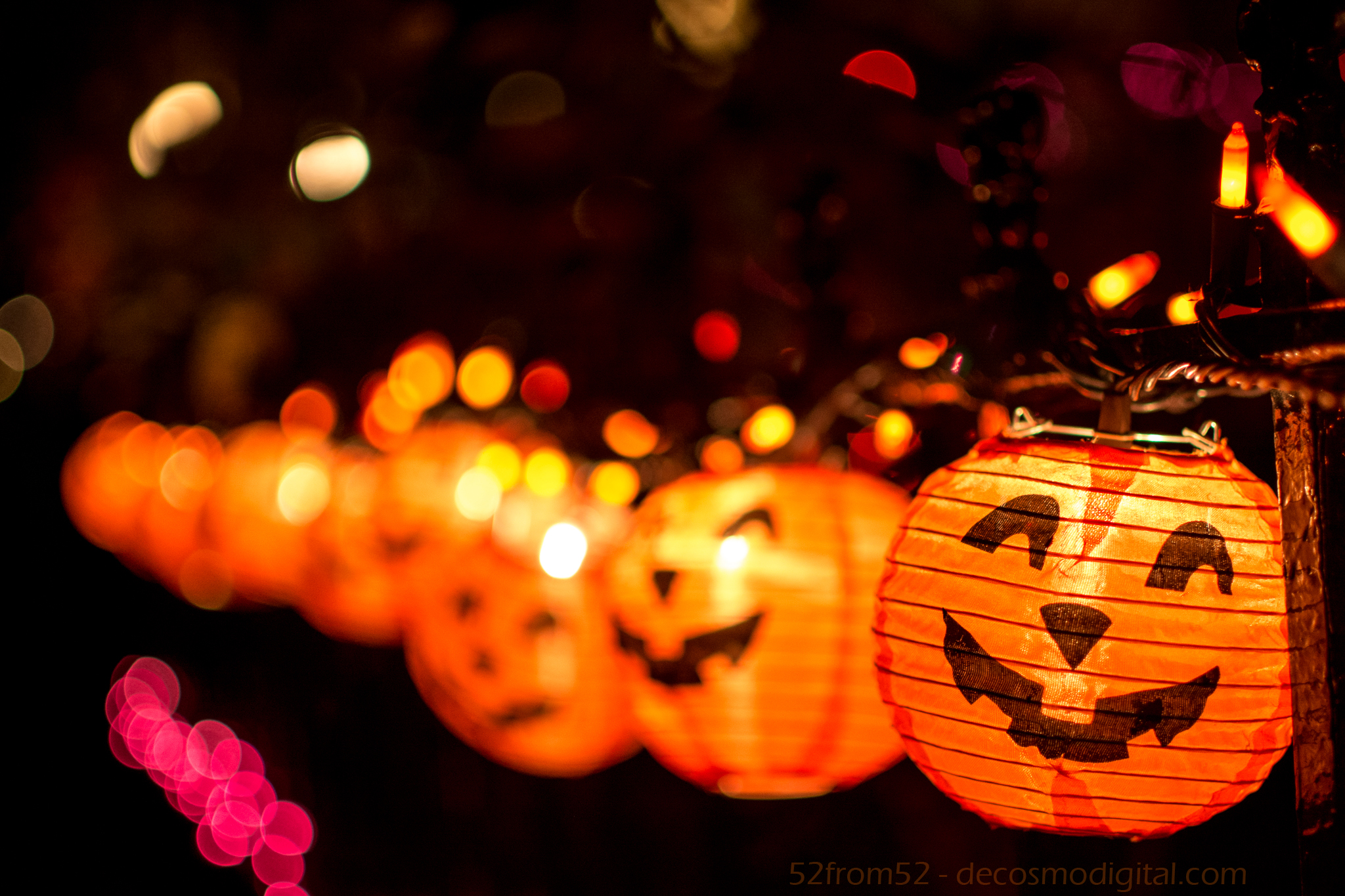
Normally I run along the water in Hoboken but on Thursday I decided to change it up and run down Bloomfield St. since lately there seemed to be this orange glow emitting from the street.  Much to my surprise the people in Hoboken are really into decorating for Halloween.  Most of the houses lining Bloomfield had at least some interlaced webbing along their stoop, if not a full out Halloween scene.  Running down the street was almost like going through a haunted house since there were witches, ghosts and spiders littered all over.  Along my path I even stumbled upon a news crew camped out around one of the more creative houses.  The news crew was likely talking about how intense and competitive decorating for Halloween gets in Hoboken.   There were so many houses I could have chosen but the one that caught my eye featured a string of jack-o-lanterns that seemed to be smiling at me.  After finding my subject I ran, literally, back to my apartment to grab my camera (no I didn’t run with it!) and went back out to get my shot.

Photography concepts:

Like in my other night pictures the biggest challenge was dealing with the low amount of light.  My subject (the jack-o-lanterns) were nice enough to emit a good amount of orange glowing which enabled me to drop my ISO.  Hopefully by now you know what ISO is and how it’s related to light, if not circle back and read either my week 3 or week 4 blog.  Back to ISO, thanks to the light coming from the lanterns I could shoot my picture with an ISO of 800.  I probably could have gone lower but I didn’t want to creep in front of some persons house for too long.  Using the lower ISO left my picture looking crisp rather than grainy as is usually the result from a higher ISO.

The other aspect of the “triangle of photography” which helped shape my picture was the aperture that I used.  In this picture my aperture was f/2 which is part of why I was able to shoot with a low ISO.  f/2 is one of the largest apertures you can use and lets in a lot of light.  One of the results from using wider apertures is the background blur caused by a shallow plane of focus that I’ve talked about in past blogs.  Having a shallow plane of focus is why you can clearly (or not so clearly) see the pumpkins gradually get more and more blurry as they move further away.

The last thing I want to point out about this picture is how I lined it up.  It’s often tempting to take a picture head on but I highly encourage you to try to find a unique angle that perhaps you wouldn’t see while walking around.  Not too many people would bend down and look straight down the line of jack-o-lanterns.   Anyone passing by might stop and look at the lanterns head on, this is why finding a unique angle is way more interesting.  Get low, get high (legally), and find that unique angle!
Rushing to/Rushing from…

ISO 400, 35 mm, f/3.2, 1/80 second

ISO 400, 35 mm, f/3.2, 1/80 second, -2 stop exposure

Week 7 (9/15/2013 – 9/21/2013): Hoboken Terminal, Hoboken NJ
Picture Taken on 9/17/2013 at 6:55 PM

Picture Description:

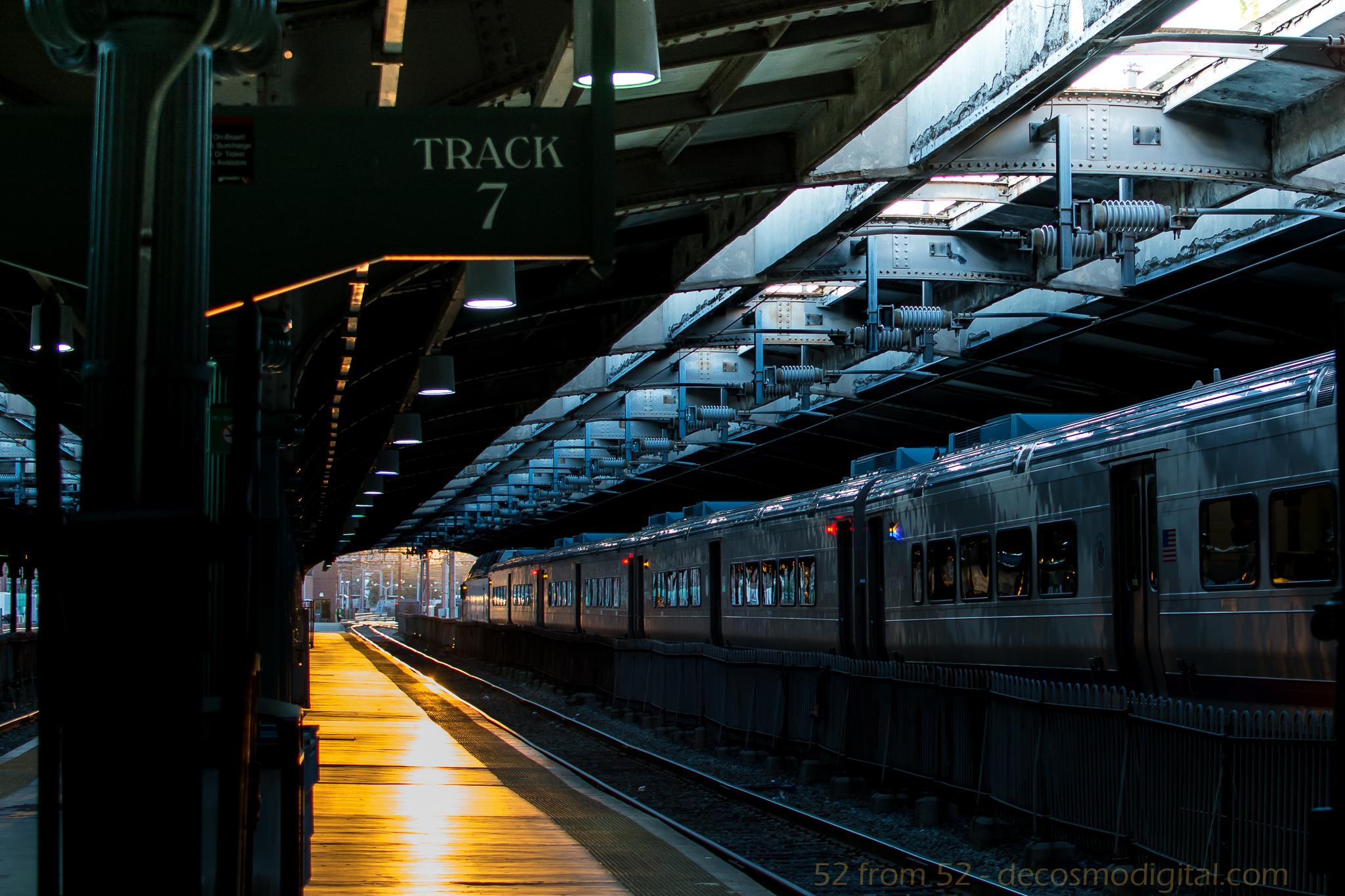
Have you ever noticed that almost everyone at train stations are in a rush? I have to admit in most cases I’m one of those people. Think back to your last time at a train station, chances are you were either rushing to or from your destination and paid little attention to your surroundings. In the rare instance (or maybe not so rare depending on how punctual you are) that you miss your train the thought of waiting for the next one can almost seem like a prison sentence. I’m no stranger to mass transit, I’ve been taking it for years and I’ve become all too familiar with the scenarios I just described. I have often wondered about all the little things I’ve missed over the years while rushing around or overlooked while being frustrated by some unplanned circumstance such as missing a train. Maybe I missed out on an interesting conversation with a passing stranger? I might have trampled right over a rare coin laying abandoned on the ground or perhaps walked past a person that needed my help with something as simple as directions. You would be surprised what you notice when you actually take the time to pause, think and observe. This concept of how people rush through train stations and life in general is what gave me the idea for this week’s post.

This week I decided to try and observe things, people and places I regularly might overlook. I’ve been riding the bus with my headphones out, phone in my pocket and head up. I made it a point to sit outside for lunch rather than eat at my desk on the computer. Besides the little day to day changes I also decided to take a trip to the train station, not to catch a train but give a photographic demonstration of what you/we often miss out on. My plan was to get to the Hoboken train station just before sunset because I knew the station was aligned East to West so there would be a good sunset down the tracks.

Upon arriving at the station it was exactly how I imagined it. I got to the station around 6:45 which is the tail end of rush hour but the station was still very busy. Crowds of people were weaving in and out of one another, some on their phones while others just with this blank look on their face. As I tried to shuffle between the waves of people to line up my shot I got tapped on the shoulder, “Can I help you?” I heard. My unusual behavior caught the eye of a police officer, apparently being the only person not rushing looked a little suspicious . I politely replied no (didn’t want to get arrested) and said I was just trying to get a sunset photograph while offering to show my pictures as proof. The police officer looked dumbfounded but said okay and walked away. I spent a couple more minutes fighting the crowd trying to get the best shot the whole time noticing that literally no one was seeing this awesome view. One person stopped and I thought they were checking it out, but it turned out they were just looking for a train time. By the end of my little endeavor I felt validated about my rushing theory and accomplished that I was able to get the the exact picture I had in mind. One oddly coincidental aspect of this photo, this is my seventh blog and somehow I ended up getting a photo of track 7. This wasn’t planned but sometimes the best things aren’t…

Photography Concepts:

I applied a couple of the basic composition techniques I’ve talked about in my previous posts to deliver what I felt to be an interesting picture. The rule of thirds and leading lines are the two most main composition concepts at work in this photo. Instead of going for a symmetrical picture and having the track split my picture down the middle I went with having it take you right to left and right out of the station, or is it leading in? I felt like this picture can give the feeling that you could be waiting to leave, or you just said good-bye to someone leaving you with nothing but an empty track. Basically when someone looked at the photo I was hoping they would almost ask the question, am I coming or going, am I rushing to or rushing from?

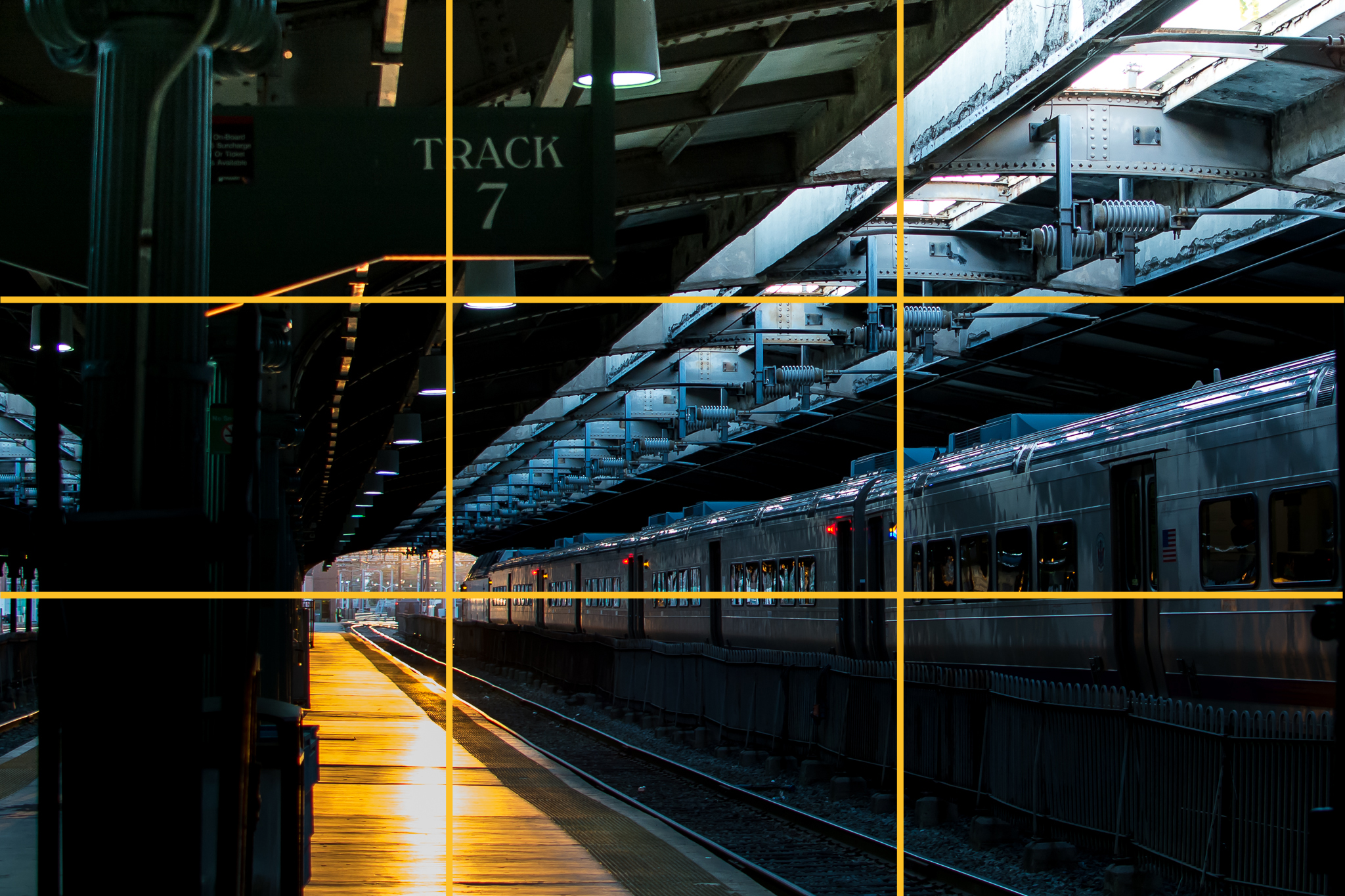
Ruleofthirds2

The rule of thirds gave less of a message and was more of the framework for lining everything up. I put the train right on the bottom third intersection line and did my best to have the exit for the station at the intersection point of the bottom and left thirds lines. The last two main pieces of the picture were the track sign and the empty platform, I lined both of those up along the left thirds lines. You might be saying to yourself wow you gave lining up a lot of thought. Surprisingly I really didn’t think too much while framing everything. Over the past couple of weeks as I have taken more and more pictures along these guidelines I’ve started to do it automatically. I’ve noticed a big difference in the pictures I’ve been taking, and judging by peoples comments they have too. Don’t take my word for it, pay more attention to lining up your pictures and see what you think or better yet what other people think.

First Post!

Picture Specs: ISO 100, 35mm, f/1.8, 1/100 sec

Picture Specs: ISO 100, 35mm, f/1.8, 1/100 sec

Week 1 (8/4/2013 – 8/10/2013): Hoboken uptown Pier
Picture taken on 8/6/2013 at 5:45AM

Picture description:

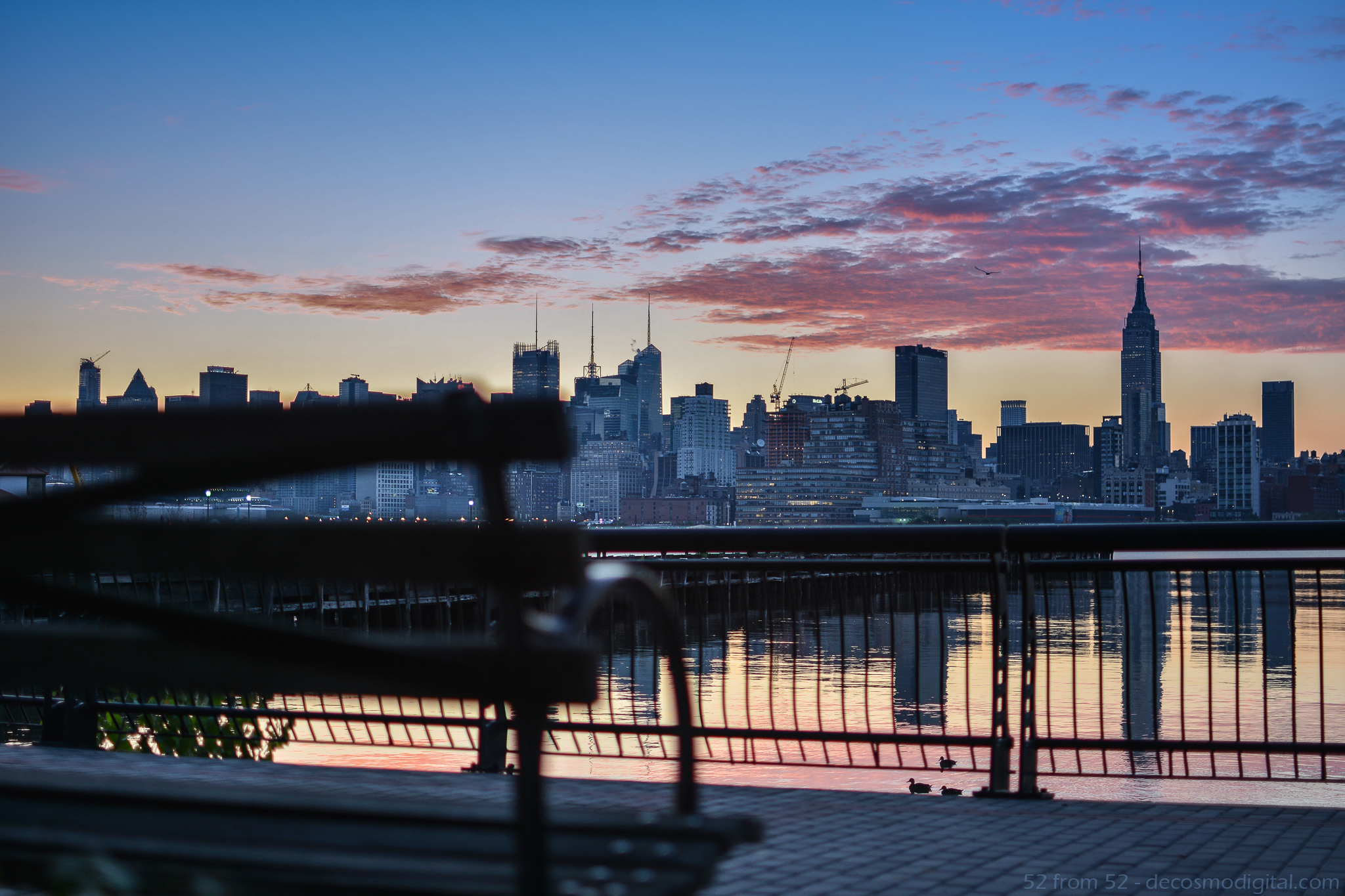
For those of you that follow my instagram or are friends with me on facebook you’ve probably noticed I like to take pictures of the New York City skyline, particularly from the Hoboken piers.  Initially I told myself I wasn’t going to start with a skyline shot but in the end it made the most sense for at least one BIG reason.  Taking skyline pictures is pretty much what got me into photography in the first place. The more skyline pictures I took the more I realized how much I enjoyed taking pictures and that I really needed a better camera.  The second reason this picture is significant is because it’s by far my favorite spot in Hoboken.  I’ve dubbed this “my bench” and usually spend at least one morning/evening a week sitting here soaking in the view.  Whether I’m drinking my morning coffee or taking a breather after a run on the pier, I often find myself back at this bench.  My favorite time to sit here is the early morning for a couple reasons; there are a lot less people walking around, you hear tons of birds chirping and waves crashing during high tide, and you obviously get a great view of the sunrise.  It’s very tranquil and a great way to start out your day.  Trying to capture the feeling of sitting in this bench is why I decided to start out with this picture.

Photography concepts:

First I shot this picture at f/1.8 which is the widest aperture (opening of the lens) and shallowest depth of field I can take.  It might seem odd but the smaller the ‘f’ number the larger the opening of the lens is.  While the larger the ‘f’ number the smaller the opening is and the more things are in focus.  I took this picture with a small ‘f’ (fstop/aperture) of 1.8 initially to put the bench in focus and blur out the skyline but after trying one in reverse with my focus point on the buildings, I liked this one better.  Shallow depth of fields give that blur effect and are hard if not impossible to pull off with a camera phone since you can’t control your camera’s lens opening like with a DSLR.  For my fellow instagramers, the blur feature on instagram is meant to mimic depth of field shots but it’s limited to the circle or straight area.  I felt like by using the shallow DOF in this picture it makes it easier to imagine yourself sitting on the bench.

The second concept in play is the rule of thirds.  In this picture the bench is in the far left/bottom third of the picture with the rest of the scene in the middle/right thirds.  For anyone that doesn’t know about the rule of thirds, it’s just breaking the picture into thirds vertically and horizontally (seen below).  This results in 9 boxes with 4 intersection points.  It’s said that by putting subjects or things such as eyes on these lines makes for more dramatic pictures.  In my picture the bench  is on one of the intersection points and clouds are on two.  Using the rule of thirds in this way helps you focus on the sky and give you the feeling of looking out from the bench from left to right.

DSC_0023-ruleofthirds

The last sort of “concept” that I want to point out is the timing of the shot.  When shooting sunrises or sunsets it’s said that the best light is +/- 30 minutes of the actual sunrise or sunset time.  On the morning of this picture the sunrise was at 5:58 AM.  I got to my spot a little later than I had hoped (hit the snooze a couple times) but I still managed to get the light I was looking for.  Once it got close to and then past the actual sunrise time the colors seemed more washed out.  Overall I’ve learned that my favorite time to take pictures of the sunrise is before the time and for sunsets is after.