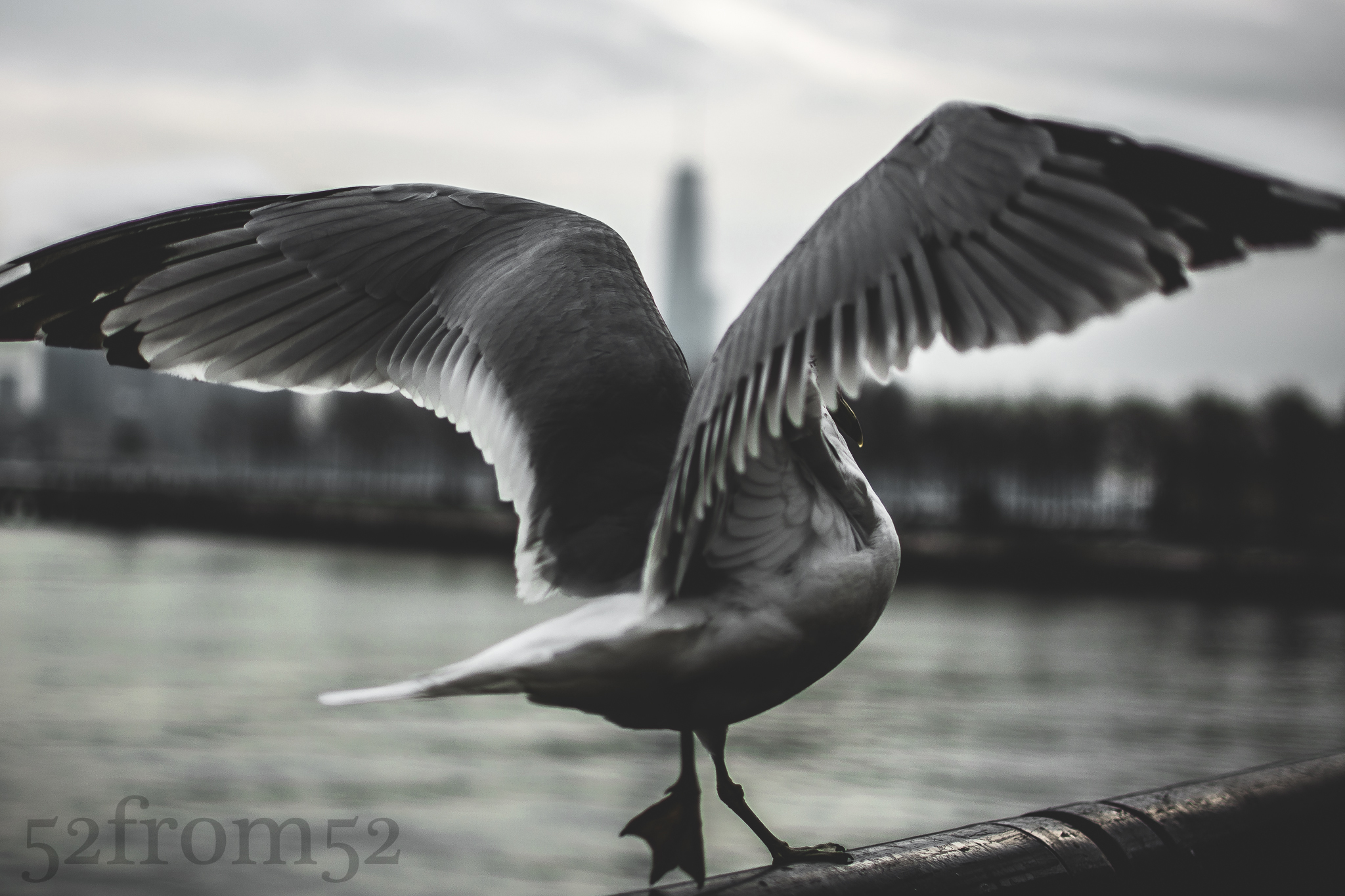
Time Flies

Picture Info: ISO 100, 35mm, f/1.8, 1/4000 sec

Picture Info: ISO 100, 35mm, f/1.8, 1/4000 sec

Week 30 (2/24/2014 -3/2/2014): Hoboken Waterfront

Picture taken on 3/2/2014 at 12:14 PM

Photograph description

Wow week 30 and I can’t believe how fast time has flown since I started this project.  Doing this photoblog is one of the best decisions I’ve ever made.  I have learned so much, made some new friends and have become even more hooked on photography.  That being said, I’m excited to see what the next 22 weeks will bring!

I was a little off my game this week when it came to taking pictures.  Usually I get out about 1-2 times per week, this way once Sunday hits I have some options for my post.  I’d like to say my lack of photo time was because it was hard to find time, but it was mainly hard to find the motivation to get out and fight the cold.  Waking up Sunday I felt the pressure to find a good picture to feature and lucky for me it wasn’t too cold.  As I have so often this winter, I went out along the Hoboken waterfront to see what I could find.

To get in the mood I threw on some headphones and lost myself in the hypnotic beats of Armin Vann Burren on SiriusXM’s electronic area.  Oddly enough electronic music has the ability to both get me amped and sooth me, sometimes simultaneously.  This time around Armin’s mix had more of a relaxing effect as I strolled around in the cloudy day.  After looping around the newly opened walkway that encircles the 4th street field, I came upon a surprisingly brave seagull.  No matter how quickly I moved towards him the seagull would only fly out a few feet then perch right back on the railing.  This seagull’s challenging attitude provided me with a unique opportunity to adjust my camera settings to find the ideal exposure and composition.

Photography concepts:

Shooting fast, shooting often and anticipating movement are the keys to photographing birds and most animals.  Shooting fast and often seems pretty obvious but the trick is knowing how to set up your camera to do so.  Ideally you want to use your camera’s fastest shutter speed.  The easiest way to get a fast shutter speed is to shoot with a large aperture.  The aperture will vary based on available light, but in most cases your safest bet is to shoot wide open at your lenses largest aperture.  My lenses widest aperture is f/1.8.  Shooting at my lenses maximum aperture allowed me to achieve a super fast shutter of 1/4000 of a second.  You may have noticed that even with shooting as fast as I did, the seagulls wings are still a just a little blurry.  It’s possible the blur is due to a little lag in focus but I’m pretty happy with my camera’s ability to focus quickly so it’s more likely due to a small plane of focus.

Now how to shoot often? My camera and most other DSLR’s have different shooting modes which allow for faster frames per second.  The fastest my camera will shoot is 5 frames per second.  This allowed me to hold down my shutter release button and let my camera fire off lots of consecutive bursts to capture all the action.

Now even with a fast shutter and my camera firing off almost continuous bursts, all would have been lost had I not positioned myself correctly.  Birds and other animals usually give away their next move by the way they orient their body or with their body language.  In the case of this seagull when he was about to fly he usually dipped his head and obviously started ruffling his wings.  I took his flight cues and  body orientation as my cue for where to lead my camera and when to start shooting.

One  last point worth noting, although I shot at f/1.8 I could have shot with a smaller aperture by increasing my ISO.  The reason that I shot at f/1.8 was to get the background totally blurred.  If you don’t want the background blurred raise your ISO and shoot with a smaller aperture.  Shooting with a smaller aperture will also give you a bigger margin of error in terms your plane of focus.  Don’t take my word for it, play around with your settings to find the look that you like.  Just remember you might only get one shot at the picture so practice and know what your settings are before you approach your subject.
Cameo

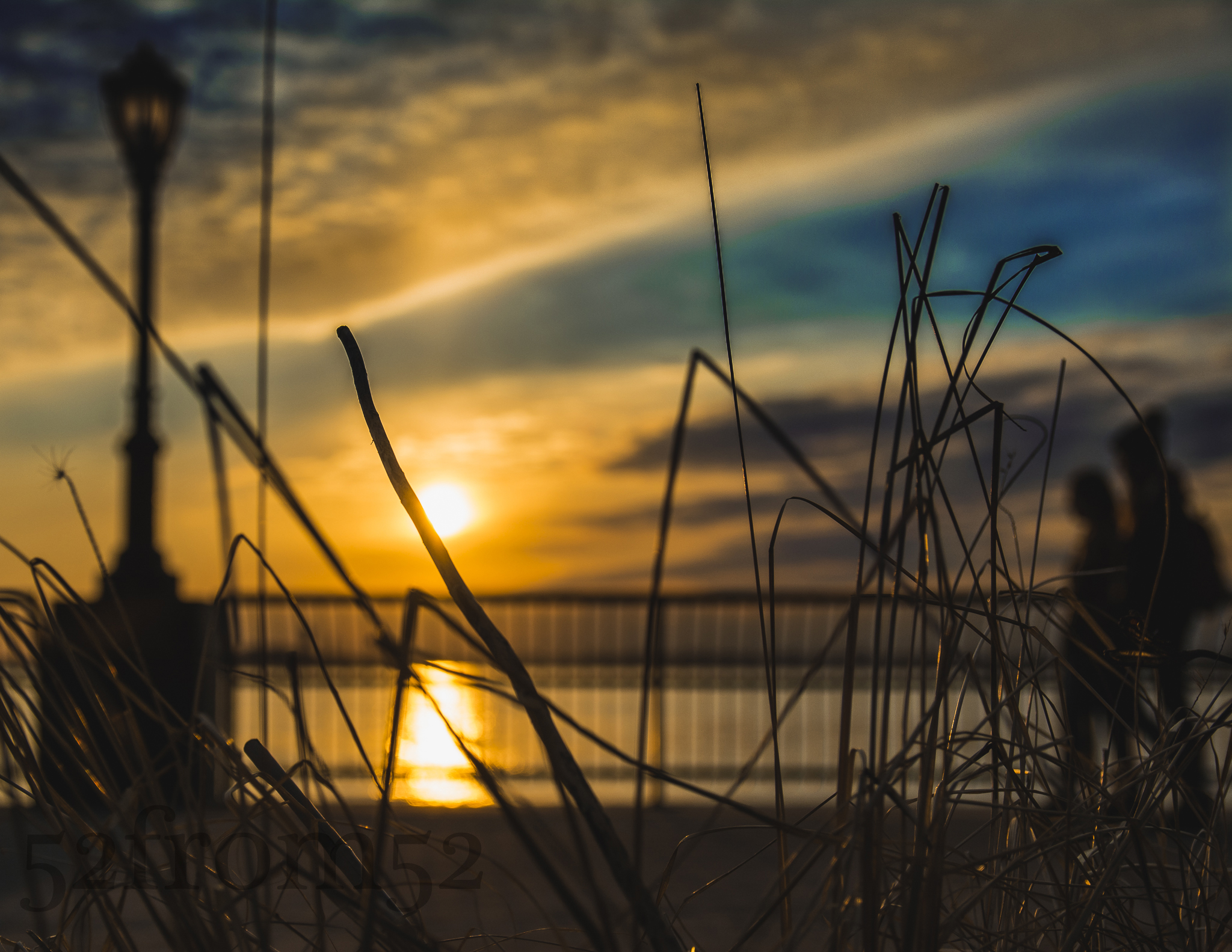
Picture info: ISO 160, 36mm, f/4.0, 1/4000 sec

Picture info: ISO 160, 36mm, f/4.0, 1/4000 sec

Week 29 (2/17/2014 -2/23/2014): Wagner Park, New York, NY

Picture taken on 2/23/2014 at 5:13 PM

Photograph description:

There is a first for everything, and this week was a feast of firsts. For starters, this week was the first time that I didn’t post within my weekly deadline.  After a busy weekend when it came time to write my post on Sunday night, I  couldn’t resist collapsing face down on my plush tempurpedic.  Other than my latent post, this week also marked the first time that my post’s picture was shot with something other than my Nikon 35mm f/1.8 lens.  I still shot my picture at ~35mm but this time it was with a new  Sigma 17-50mm f/2.8.  I had been tussling with whether or not to buy a new lens for a couple of weeks.  Last week I was finally able to validate purchasing a new lens.  One of my stocks recently started to take a hit so I decided to cut bait and divert those funds to the investment of a new lens.  Hopefully the lens will pay better dividends.  

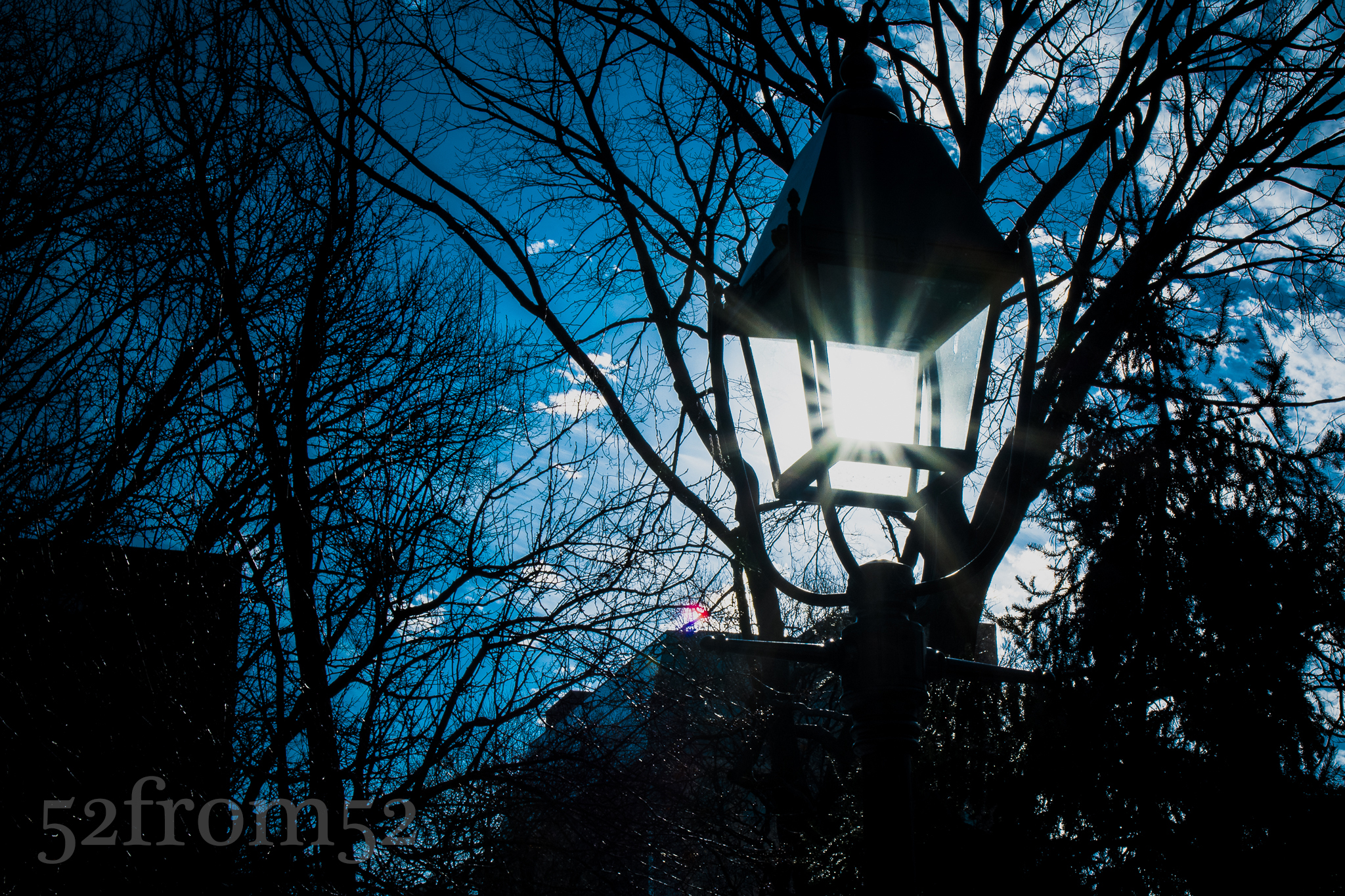
The last two “firsts” worth noting are locations based.  This week was the first time that I visited Washington Square park and the nearby Stumptown coffee shop.  I’ve been to the Stumptown on 29th street a few times but never the second and smaller location by Washington Square park.  It was nice finally checking out the park  even if it wasn’t the best time of the day for pictures.  The sun was at about 45 degrees and blindingly bright.  After walking around the park for a few minutes with my friend that tagged along we decidle split off from one another so we could each focus on finding the best shot.  As I moved away from the park’s iconic arch I found a couple ways to use to the sun’s harsh angle.  One was to shoot some reflection pictures using the wet ground.  The second idea I had was to line the sun up within the street lights that littered the park so it looked like they were glowing in the daylight.  Although both were fun ideas, they quickly grew old so I decided to find my friend and search for a better location.

Washington Square Park Light Post

Washington Square Park Light Post

With sunset approaching we decided to head to Wagner Park located at the southern tip of Manhattan.  I shot at that location once before during week 16 but since it provides great sunsets, I knew there was no harm in taking a return visit.

While on our way south we seemingly stopped every couple of feet to take pictures.  Since the purpose of our trip was to take pictures, frequently stopping wasn’t a problem, but it was threatening our chances of getting to the park at the right time.  Eventually we decided to jump on the 1 train to expedite our journey.

Once we got out of the subway we made a beeline towards the park.  When we finally cleared the tall buildings of the financial district, I yelled out “boomshakalaka” in excitement once I saw the beautiful evening sky.  For the next hour or so my friend and I were treated to one of the better sunsets I’ve seen in a while.  We both shuffled around the park trying to find the best shot.  I eventually spotted a patch of tall grass which provided me with a good foreground subject and sealed the deal for this week’s picture.

Photography concepts:

Since this week is the first time shooting with my new Sigma lens it makes sense for me to talk about some of the advantages it provides.  One of the advantages which benefited this week’s picture is the Sigma’s nice bokeh.  As I talked about last week, bokeh is the part of the picture that’s out of focus.  One thing I recently learned is that with nicer lenses the bokeh is smoother and although it’s a little bit of an oxymoron, the out of focus images are sharper.  The nice bokeh worked well for creating silhouettes of the lamp post, railing and couple walking.

Another advantage the Sigma has is a low fixed aperture of f/2.8. Although the Sigma doesn’t beat my Nikon 35mm’s f/1.8 aperture it’s still large enough to make shooting indoor and night pictures easier.  The Nikon beats the Sigma aperture but the Sigma has a 4-stop Anti-Shake feature which allows for slower shutter speeds.  This means that although the Nikon can let in more light via a wider aperture, the Sigma can let in more light via slower shutters (without using tripods).  The term 4-stops means I can go 4 stops lower than the recommended shutter speed for a specific focal length.  When shooting at 35mm (52 with a crop sensor) it’s recommended that I stay at or above 1/100 of a second.  Thanks to the anti-shake feature I can hit a shutter speed of 1/40 of a second, and possibly slower if I have any added stabilization.  This is a moot point if you’re using a tripod but it’s very relevant when you’re shooting indoors or at night.

The last advantage I’ll quickly mention because it’s not one that can help me during my 52from52 photoblog series is that the Sigma is a zoom.  The advantage of having a zoom lens is pretty obvious.  With a zoom you’re able to recompose your picture without moving and hit targets that a 35mm prime can’t.  Because it’s a zoom I might use my Sigma again in some upcoming posts, not to shoot my picture from another focal length, but so that I have some flexibility for the pictures not meant for this blog.  The Sigma’s focal length range 17-50mm ( ~25-75mm) is very versatile.  The lens moves from wide angle to a nice focal length for taking pictures of people, especially when I can maintain a f/2.8 aperture.  The possibilities this lens has is exciting so stay tuned!

Saturday Night Focus

Picture info: ISO 1000, 35mm, f/2.0, 1/50sec

Picture info: ISO 1000, 35mm, f/2.0, 1/50sec

Week 28 (2/10/2014 -2/16/2014): Hoboken, Washington/13th

Picture taken on 2/15/2014 at 7:52 PM

Picture description:

Like many people my age, on a usual Saturday night there is a good chance you’ll find me out at a bar with friends.  This past Saturday night however was not my usual evening.  This weekend was different because I was providing 24/7 support for work.  Working in IT has it’s perks but it also occasionally carries some unique responsibilities, one of those being support coverage.  This weekend was the first time I held this role in a long time and it’s not one that I take lightly.  While covering support I need to maintain my wits and have a quick response time if I get any calls, therefor going out to a bar isn’t on my social menu.  

Original "accidental" picture

Original “accidental” picture

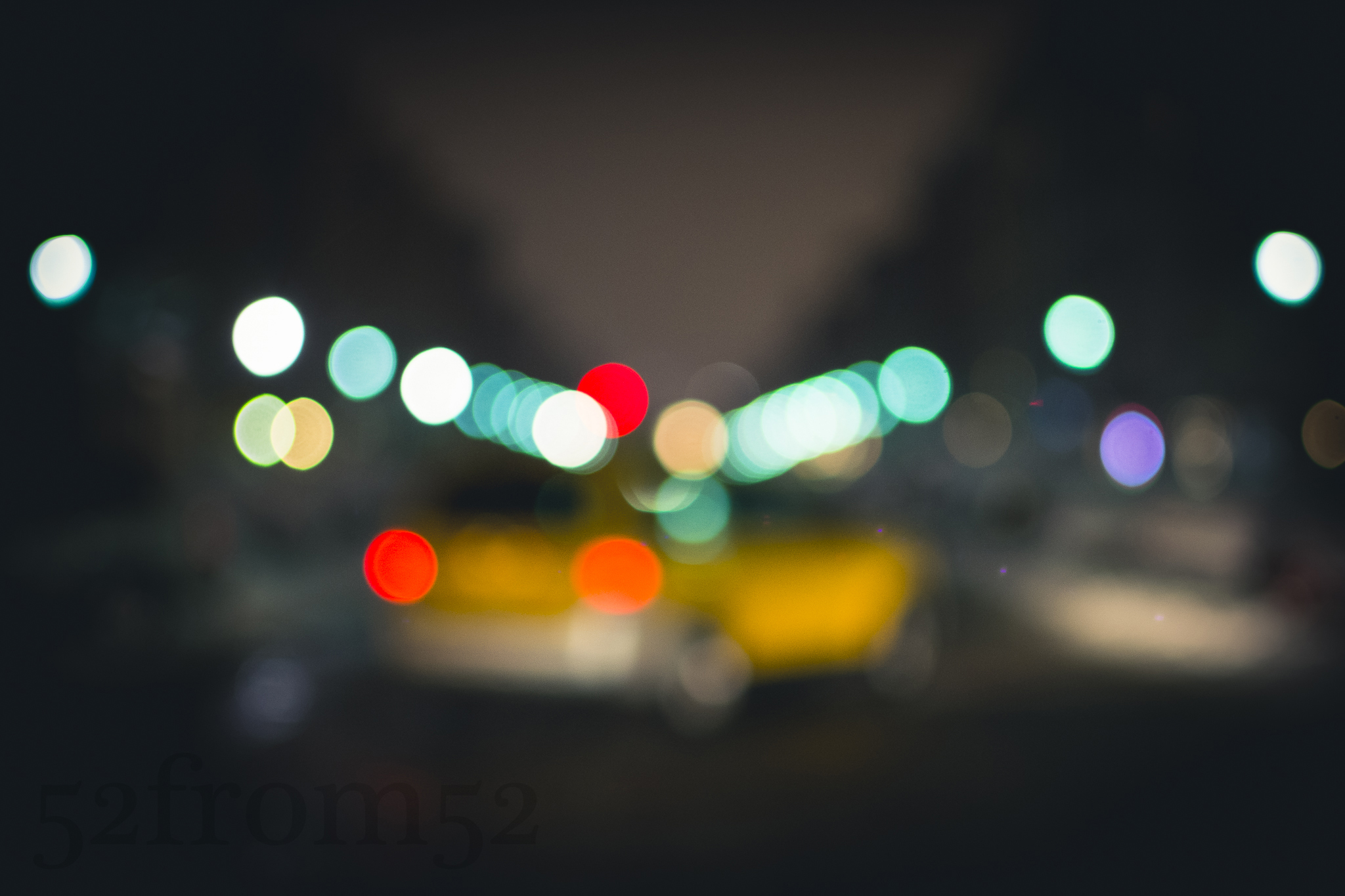
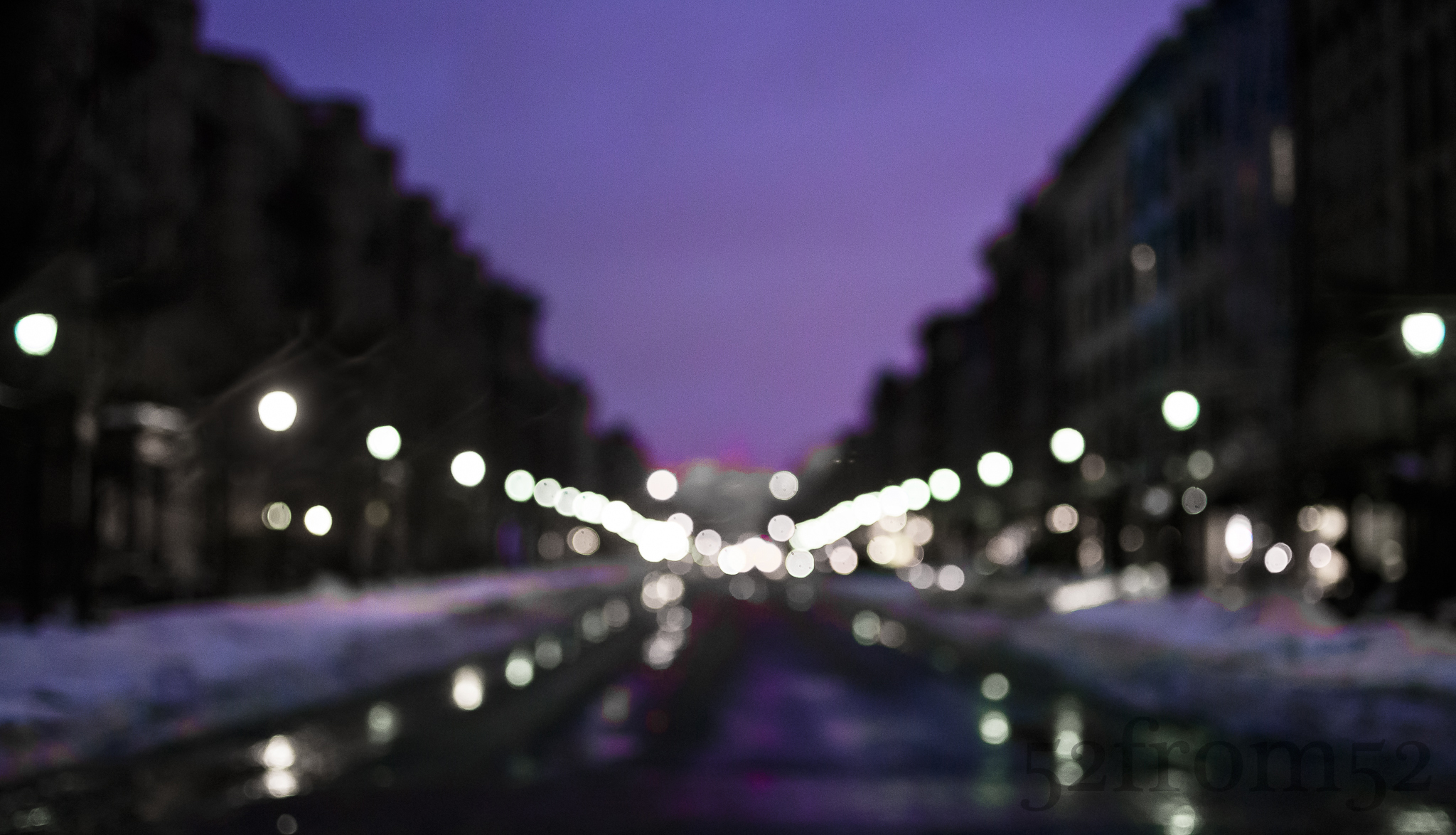
Coincidentally this weekend the newest season of “House of Cards” released on Netflix so that provided the perfect means to pass my Saturday night.  Though I had a good TV binge in the queue, I decided to pop outside for a little with my camera.  Earlier in the week I took a picture which I planned to use as this week’s post.  My goal for Saturday night’s picture hunt was to try my hand at recreating and or improving my previous picture.  The original picture was shot on Washington street and was more of an accident than a planned image.  When you’re attempting to take a picture in the middle of the street you can imagine how one might feel rushed.  It could be the possibility of getting hit, or just the fact that people gaze upon you like you’re crazy. Regardless of the reason, while shooting my original picture from the middle of the street I felt rushed and thus fired off some quick pictures, a few of which were not in focus.  After reviewing the unfocused batch of pictures, I actually liked the way the blurred imaged looked.  Fast forward to Saturday night, my goal was to not leave this round of pictures to chance.  My plan was to use the manual focus of my camera to create a “controlled” blurred image.

My chosen spot was at the corner of 13th/Washington. As I stood at the corner waiting for the light to turn red, I fiddled with my focus to get a blurry but clear enough to see image.  During one of my practice pictures I accidently got a taxi in frame which triggered the idea of creating an picture that represented how I usually recall Saturday nights.  I waited a couple of light cycles until again having a taxi staged for the picture.  Once the light turned red I darted out into the street and captured this week’s image.

Photography concepts:

The more I learn about my camera, the more artistic freedom I have to create the images that are in my head.  Although this week’s picture wasn’t an exact representation of what I mentally saw, it was close.  This is the first time I used manual focus for a featured post and I’m happy with the result.  Manual focus gives you the freedom to choose the exact focus you want rather than relying upon the camera to make the decision.  It would have been nearly impossible to shoot this picture if I only relied on my camera for focusing.  When in autofocus mode your camera needs to focus on something in order to shoot.  There is a setting to override requiring focus but it’s easier to put your camera in manual.  Putting your camera in manual focus allows you to take a picture no matter what the focus is, blurry or razor sharp.  The reason I wanted to achieve an out of focus image was because of the effect it creates.  The effect that results from images being out of focused is often referred to as “bokeh.”  Most of the time bokeh is used to create separation in a picture between the subject and background.  The intensity of the bokeh usually increases as your aperture gets larger.  This technique is used a lot in portraits such as head shots.  In my picture instead of focusing on one subject and blurring out everything else, I blurred out the entire image.  I wanted to use the blurriness to create a sense of disorientation from looking at the picture.  I also wanted to use the blurry lights to create the composition of my image in the form of leading lines.  All of the lights are pinched inward to pull your focus onto the blurred out taxi.  The leading line composition was meant to represent the usual progression of a saturday night, increased blurring over time and ending in a taxi.  

As you can see by applying some of the lessons that I’ve learned, I was able to create the image that I wanted.  Of course some chance was involved this week, but the lesson to take away is that once you start to build your photography toolbox it’s important you know what concept to take out or apply to achieve the image you’re going for.  Your creativity will always be limited to the speed that you’re able to think of your feet and apply your knowledge.

“Snowboken”

Picture info: ISO 100, 35mm, f/11, 1/80sec

Picture info: ISO 100, 35mm, f/11, 1/80sec

Week 27 (2/3/2014 -2/9/2014): Hoboken, Maxwell Park

Picture taken on 2/3/2014 at 1:09 PM

Picture description

It’s said that the day after the Superbowl is one of the highest call out of work days of the year.  This year I was smart and decided to preemptively schedule myself for a day off on the dreaded Monday after the big game.  As it turned out I couldn’t have chosen a better day to take off, not because of a big game hangover, but because of a huge snowstorm that hit our area.  While most people were fighting both their hangovers and the weather I was relaxing comfortably in my apartment.  Even though I could spend the day sheltered from the storm, I decided it would be fun to head out into the snow with my Nikon in hand.  The only problem I faced was how to protect my camera from the wintery elements.  The solution that I came up with was simple, rubberband a ziplock bag around my camera and I was good to go, or so I thought.

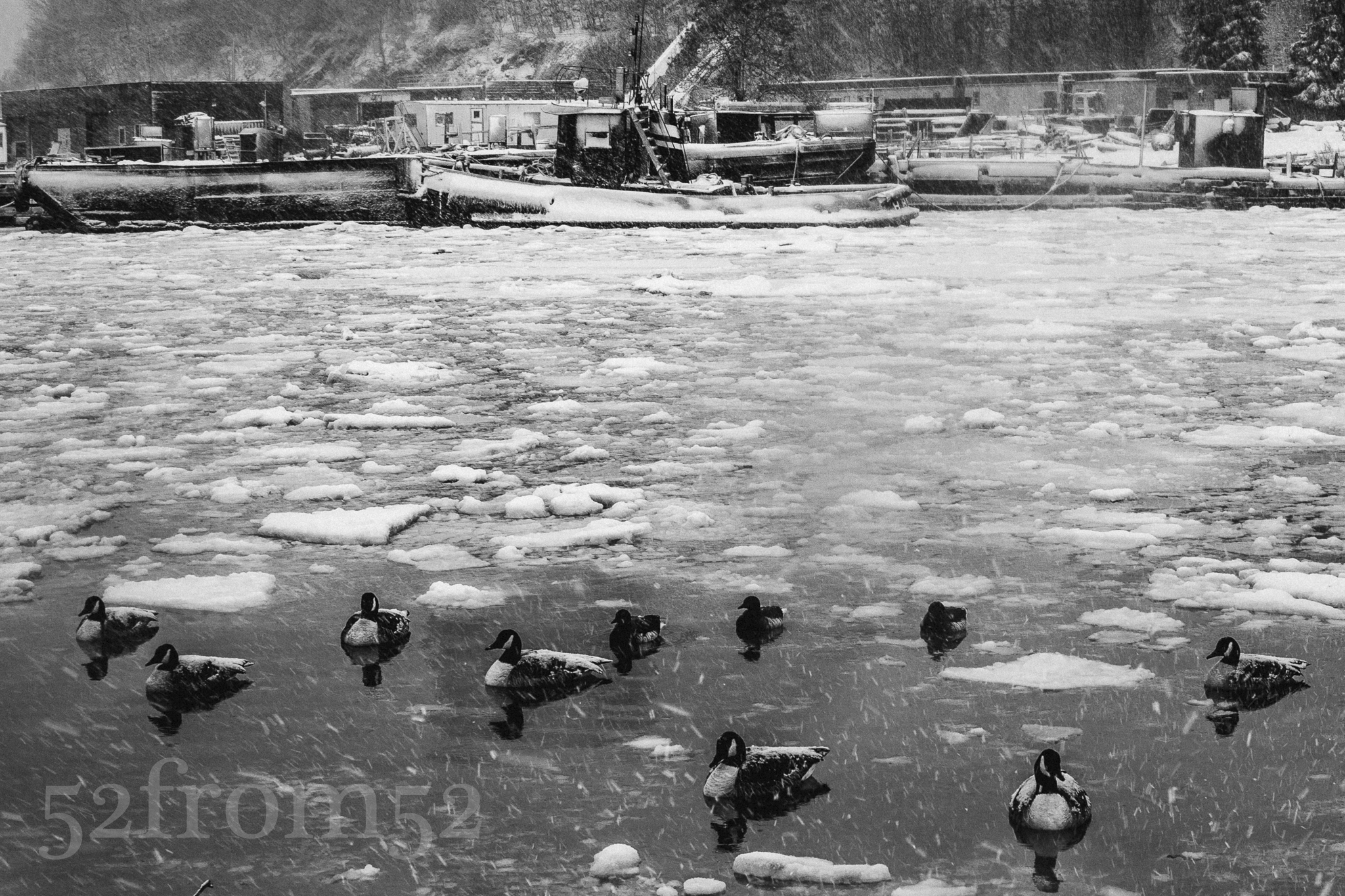
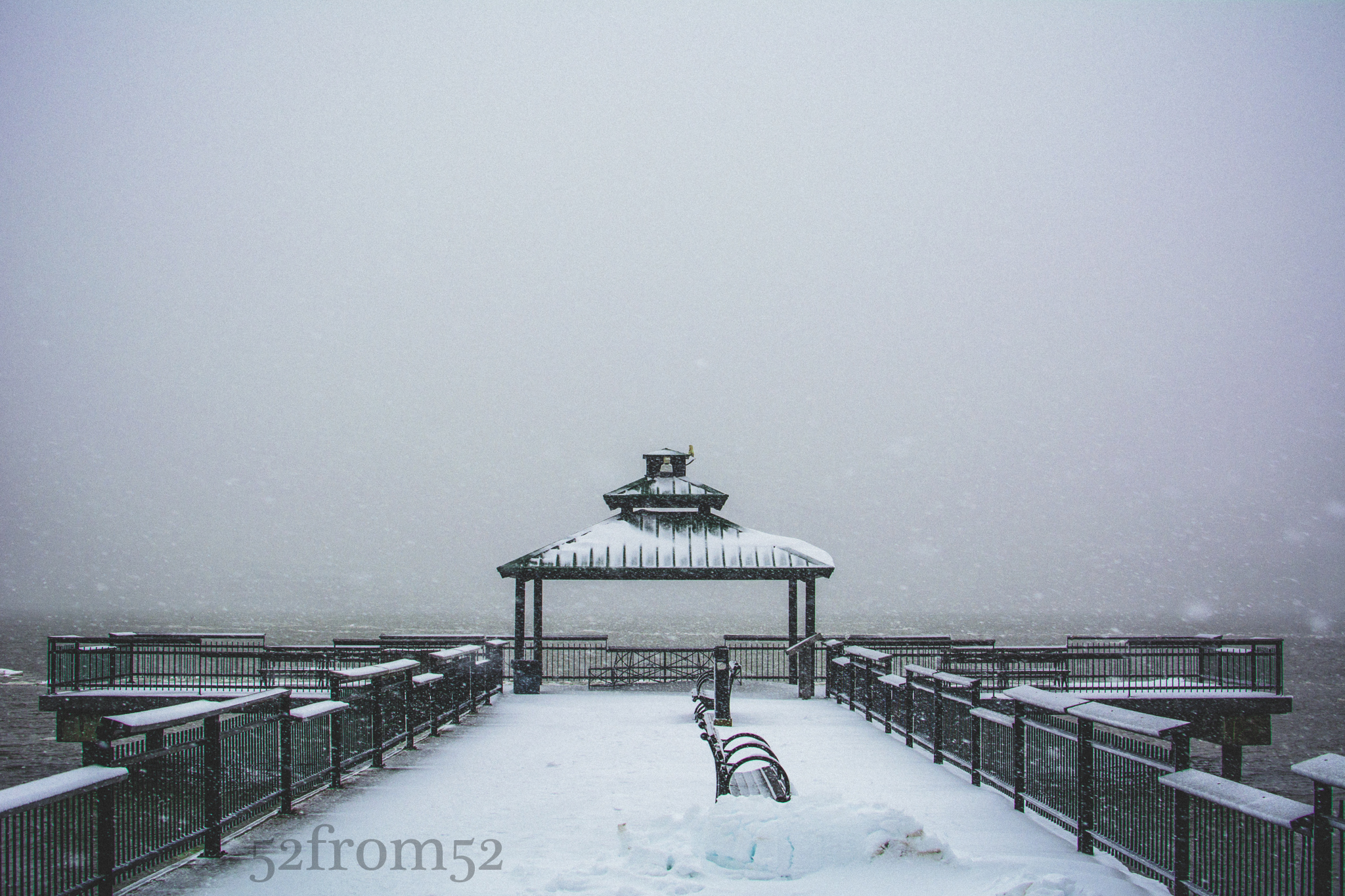
Once out in the storm my ziplock plan seemed to work in terms of protecting my camera, but it made taking photos extremely difficult.  I was able to make the best of the situation by shielding my camera within my coat until I spotted a potential picture.  Knowing that I couldn’t preserve my camera’s dryness for long, I decided to hit two nearby Hoboken locations.  First I went to my usual spot, the uptown pier at Maxwell Park.  To my surprise I spotted a family of geese trying to take refuge in the cove of the pier’s “beach area.”  They were surrounded by ice and almost seemed to be frozen themselves.  I moved around trying to shoot the geese from the best angle possible without falling into the water myself.  Next I moved to the pier on Sinatra drive by the skatepark.  Since the snow was creating a nice white out I wanted to take a picture of the gazebo on the water with nothing but a white background.  Usually the New York City skyline is the backdrop so I thought this would make for a unique picture of the area.

gazebo picture

Gazebo picture

After getting the gazebo picture I decided to head back in for the day.  I had been outside for about an hour and it seemed that my ziplock bag was close to losing it’s ability to protect my camera.  As I fought my way through the snow back to my apartment,  I said to myself next time I’ll be better prepared for the elements.

Photography concepts:

The first time out in the snow with my Nikon taught me some valuable lessons.  The first and most obvious is that you need to keep your camera dry.  Although the ziplock bag was able to protect my camera for the hour that I was out, it would have been a stretch to sustain it’s usefulness for any longer period of time.  As a result my first purchase after Monday’s snow storm was a rain cover or “rain sleeve” for my camera (link below).  They essentially work just like the ziplock bag but they’re longer and hug my arm so shooting with them is a lot less clumsy.  I was hoping for another snow storm this weekend so I could test the sleeves, but of course you never get the weather you wish for.  Expect a follow up review of the rain sleeves usefulness in a future post.   

The second lesson I learned is that you absolutely need something dry to wipe off your lens.  This seems pretty obvious as well, yet I totally forgot to bring a cloth while I was out in the snow.  I had to use some of my inner layers to wipe off my lense.  Luckily I always keep a UV filter on my camera’s lens so there was no chance of damaging the actual lens.  Using a UV filter is nothing new for me but absolutely essential when you’re out in the elements.  It’s much smarter to scratch a $10 filter than the lens of your hundred plus dollar lens.

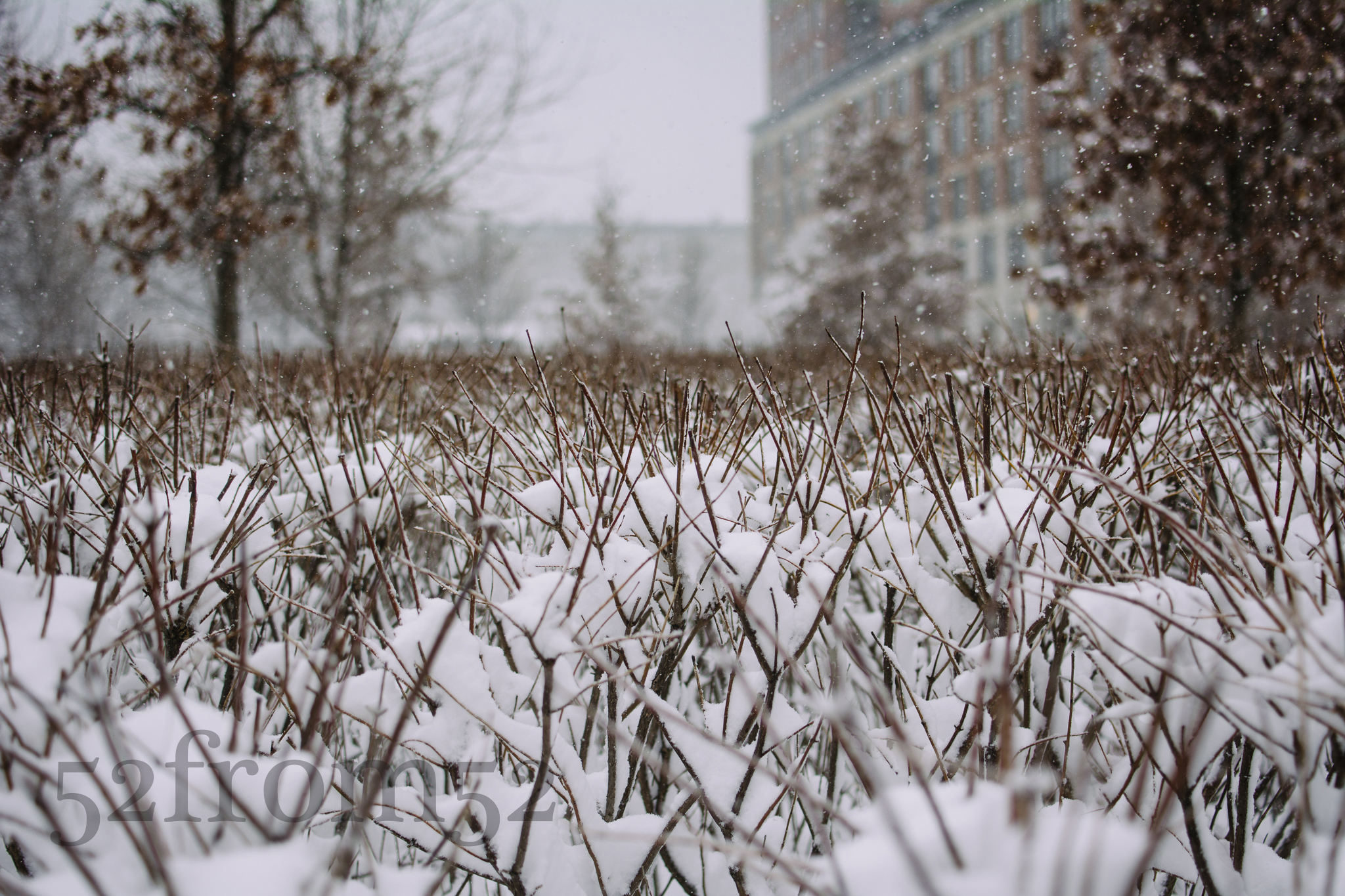
The last lesson that’s worth noting is what I learned in post (editing).  While reviewing my pictures I noticed that I didn’t take advantage of a key feature my DSLR.  Most DSLR’s, including my Nikon, give you the ability to shoot with very fast shutter speeds.  This is a great tool to have when it’s snowing (or raining) because it allows to you seemingly freeze time and capture snow flakes or rain drops midair.  I unfortunately didn’t shoot many pictures with fast shutter speeds.   From the pictures that I so happened to have a fast shutter,  it seemed that 1/1000 – 1/2000 seconds was the ideal speed to freeze the  snowflakes.  My guess is the best lens speed probably varies depending on the wind and size of the snowflakes.  Lesson learned, my shutter speed will absolutely be on the forefront of my mind next time I go out in the snow or rain.

Taken with shutter speed 1/1000 sec

Taken with shutter speed 1/1000 sec

Rain sleeve option 1

http://www.bhphotovideo.com/c/product/469774-REG/OP_TECH_USA_9001132_18_Rainsleeve_Set_of.html

Rain sleeve option 2

http://www.bhphotovideo.com/c/product/891383-REG/ruggard_rc_p18_18_plastic_rain_cover.html

Take a Guess

Picture info: ISO 100, 35mm, f/20, 3 seconds, -2.1 ND, -1 exposure stop

Picture info: ISO 100, 35mm, f/20, 3 seconds, -2.1 ND, -1 exposure stop

Week 24 (1/13/14 – 1/19/2014):  Hoboken, Maxwell Place Park

Picture taken on 1/18/2014 at 2:41 PM

Picture description:

If you’ve read my last couple of posts you may have noticed that I’ve been alluding to different goals and projects for 2014.  One of my 2014 goals is to create a collection of “Hoboken pictures” with the ultimate goal of selling them at the festivals held in town throughout the year.  I’ve been to the last couple of art and music festivals, and one thing I’ve look for each time was good (fair priced) Hoboken art and pictures.  Unfortunately I’m yet to find a booth that has both good and reasonably priced Hoboken pictures.  Knowing that current Hoboken residents, like myself, are looking for local pictures is one of the reasons I decided to take on this project.  I think this project will be a good way to take the next step in my photography adventure.  Another reason why I decided to take on this challenge is due to all of the positive feedback and encouragement that I’ve been getting from friends and family.  You all have motivated me to keep pushing myself forward by continuing to develop my photography skills and for that I thank you!

Although I won’t feature a Hoboken picture each week I’m planning on taking a lot more pictures in Hoboken.  As I talked about last week, finding new perspectives will be one of my focal points for taking pictures in 2014.  This idea particularly applies to this Hoboken picture project since no one will want to buy pictures they could have taken themselves.  The key to being successful in this venture will be getting unique pictures that people will want to feature in their homes.

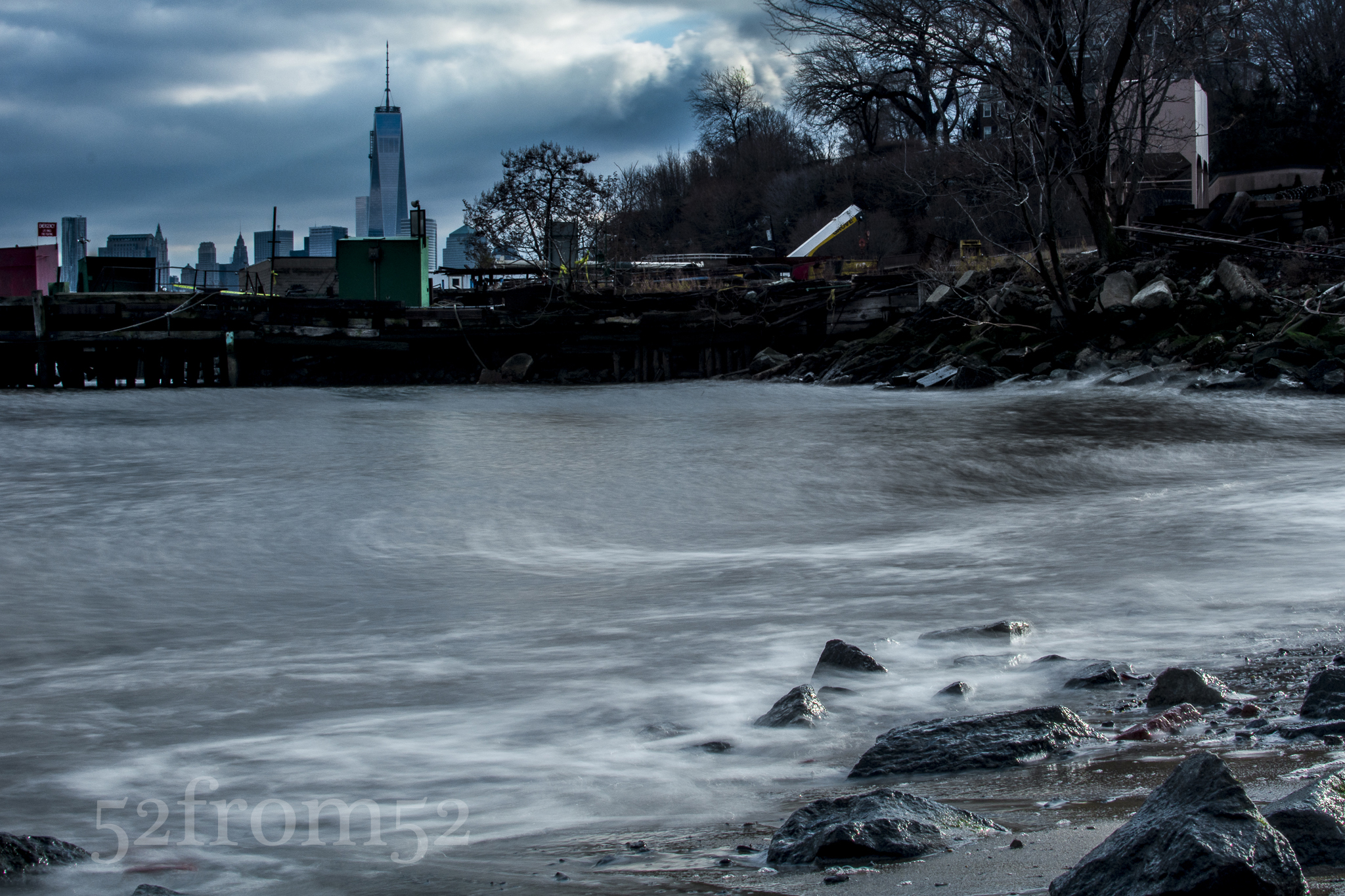
This week’s photograph is an example of finding a unique picture in Hoboken.  I’d bet that few Hoboken residents have noticed there is a beachfront in town.  During the summer the city hosts kayak and canoe days where they launch the boats from this beachhead.  It’s a wonderful location and absolutely one of the secret amenities of living in Hoboken.

20 Second exposure

20 Second exposure

Photography concepts:

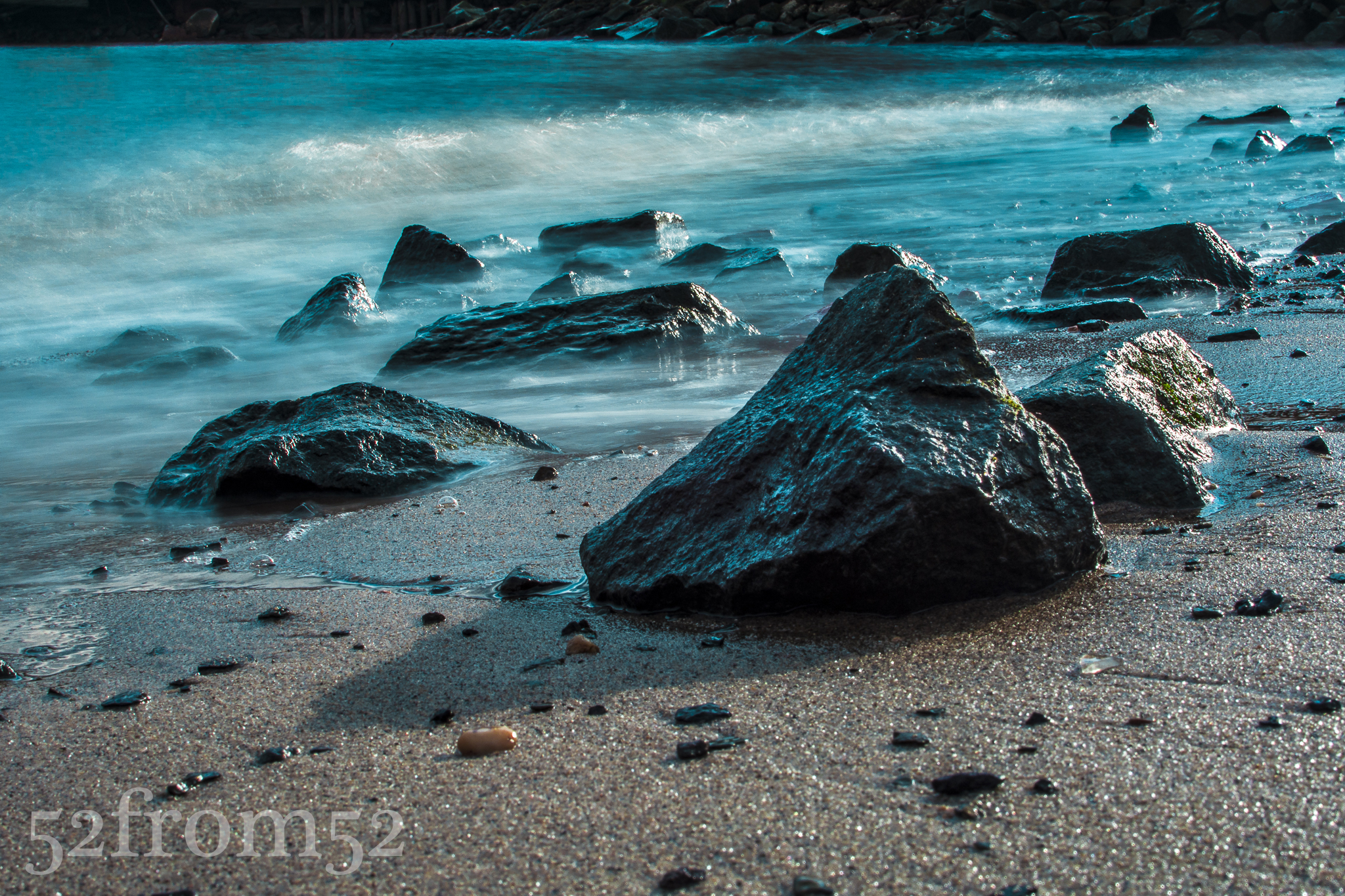
It’s been a couple of weeks since I last experimented with ND filters.  Week 17’s post “One Shot” was the first and last time that ND filters played a role in my featured picture.  Unlike in week 17, this week’s picture was shot in broad daylight.  Getting a long exposure during the day would never have been possible without using ND filters.  In this picture I stacked two filters, 0.9 and 1.2, to gain the -2.1 percent neutral density level.  In case you missed my week 17 post, ND filters reduce the amount of light that hits your camera’s sensor and thus enables slower shutter speeds.

In addition to using ND filters, shooting this picture at an extremely small aperture of f/20 is also how a 3 second exposure was possible.  Taking a long exposure of the ocean or some other body of water that has lots of movement (waves) has been on my bucket list for a while.  Since it’s the winter I’m yet to make it to the actual ocean, so until then this will have to do.  The crashing of the waves is what created the motion blur effect in the water as it crashed and receding from the shoreline.  I love that ghosting look and plan on getting a lot more pictures like this over the summer.

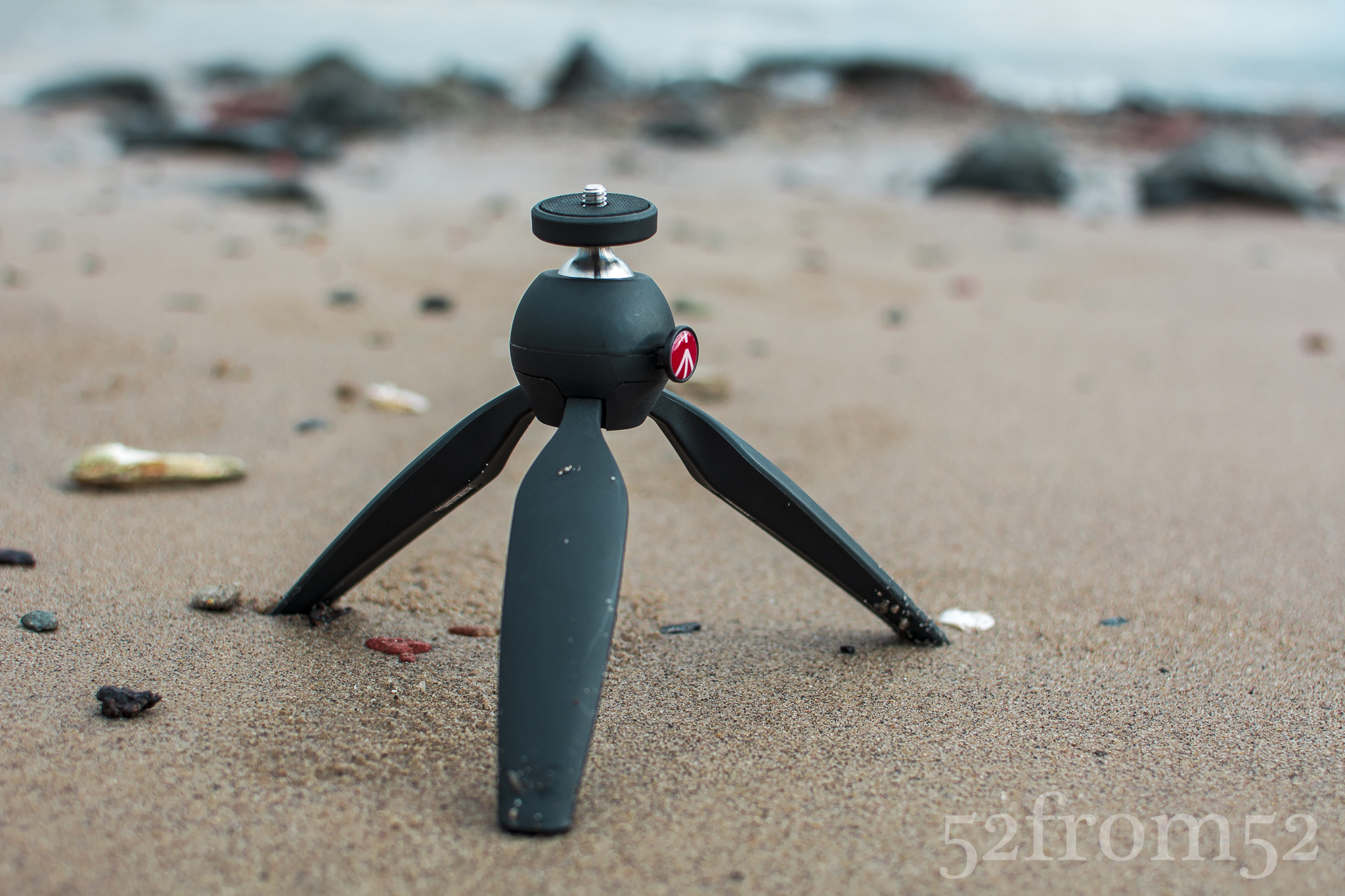
Tripod used to take photo

Mini-Tripod used to take photo (link below)

Over the past few weeks I’ve been using Instagram and Facebook to gauge the different editing techniques that people like.  Since I’m planning on selling my pictures in the near future it’s important I know what the average person likes.  I personally tend to like more dull, low contrast pictures, while I’ve found that more of the people I come into contact with like high contrast, vivid photographs.  In an effort to hit the look that people have been liking more, I’ve been editing my photos to have more pop.  It’s really hard to describe my editing process verbally, so in the coming weeks look for me to try my hand at creating Lightroom editing videos on YouTube.  Expect a follow up edit to this post with a video on how I edited this picture.

Tripod: http://bhpho.to/1jkddfR

New Perspective

Picture Info: ISO 500, 35mm, f/11, 1/320 seco

Picture Info: ISO 500, 35mm, f/11, 1/320 seco

Week 23 (1/6/2014 – 1/12/2014): Pier C, Hoboken NJ

Picture taken on 1/12/2014 at 3:58 PM

Picture description

A new year and a new perspective.  One of the keys to making progress is the idea that only by searching for new ideas and perspectives will you truly grow.  Therefore finding new perspectives in life and photography is my goal for 2014.  This week I decided a good way to challenge myself would be to set out in Hoboken to find a new perspective on some of the locations I’ve so often photographed over the past year.

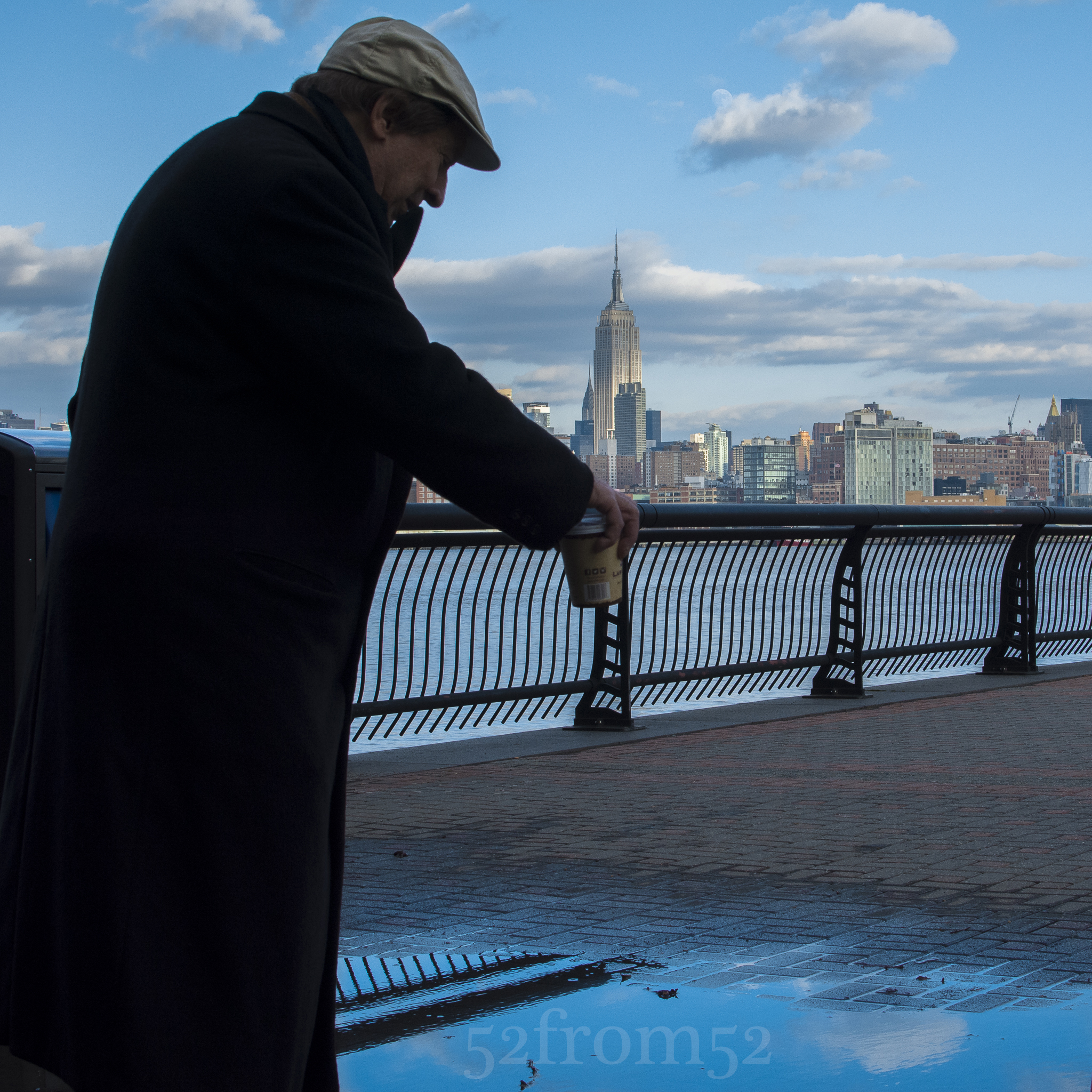
Starting out on 4th street I begin working my way towards Pier A park.  When I arrived at the park I noticed that there were quite a few puddles still around even though it was a bright blue sunny day.  I’m a big fan of puddle pictures, so I set my sights on one rather large puddle at the corner of Pier A.  As I crouched down to get a good angle an old man tapped me on the shoulder and asked what I was photographing.  I proudly hit my camera’s review button and showed him my most recent shot.  He responded with a “Wow” and told me that reminded him of something he did when he was young.  Intrigued, I asked him what it was that he did with puddles when he was young?  He proceeded to stand over the puddle and intensely look down into the shallow pool of water.  I initially thought he was checking himself out but then he explained what he was doing.  He was standing at such an angle that he couldn’t see himself, just the reflection of the sky in the puddle.  He said I’d stand here and look, look into the puddle, and if you do it long enough you can lose yourself in it’s reflection.  Little did this man know he had just in part described my goal for the day.  You see as this man stared into the puddle he wasn’t simply looking at the ground, no he was gazing into the deep blue sky but only from a new perspective.  As the old man stood there for a few more seconds in silence I could see he was adrift in the skies reflection and found happiness from this new perspective.  That’s what I want in 2014, I want to find happiness through the eyes of a new perspective.

The "Old Man"

The “Old Man”

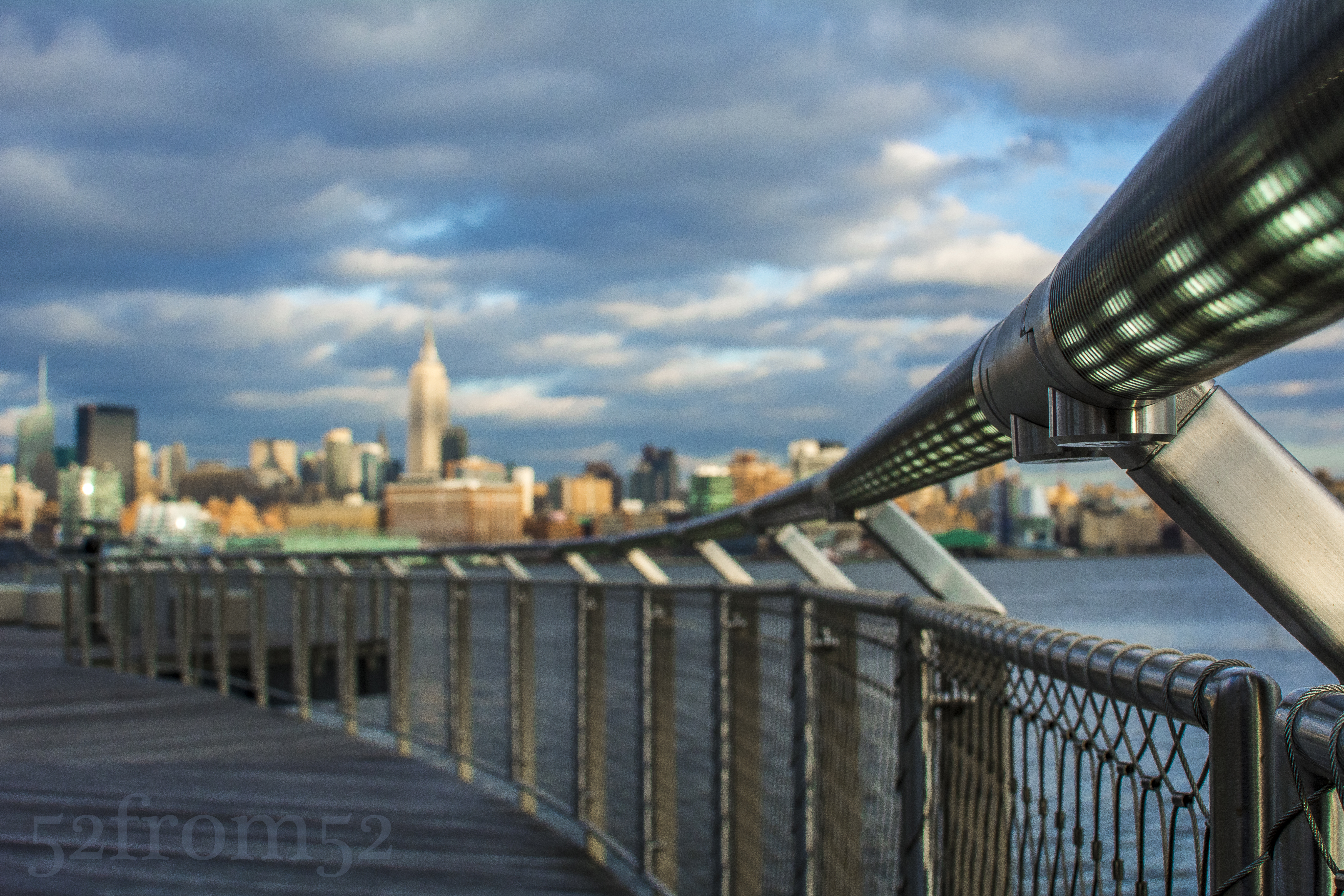
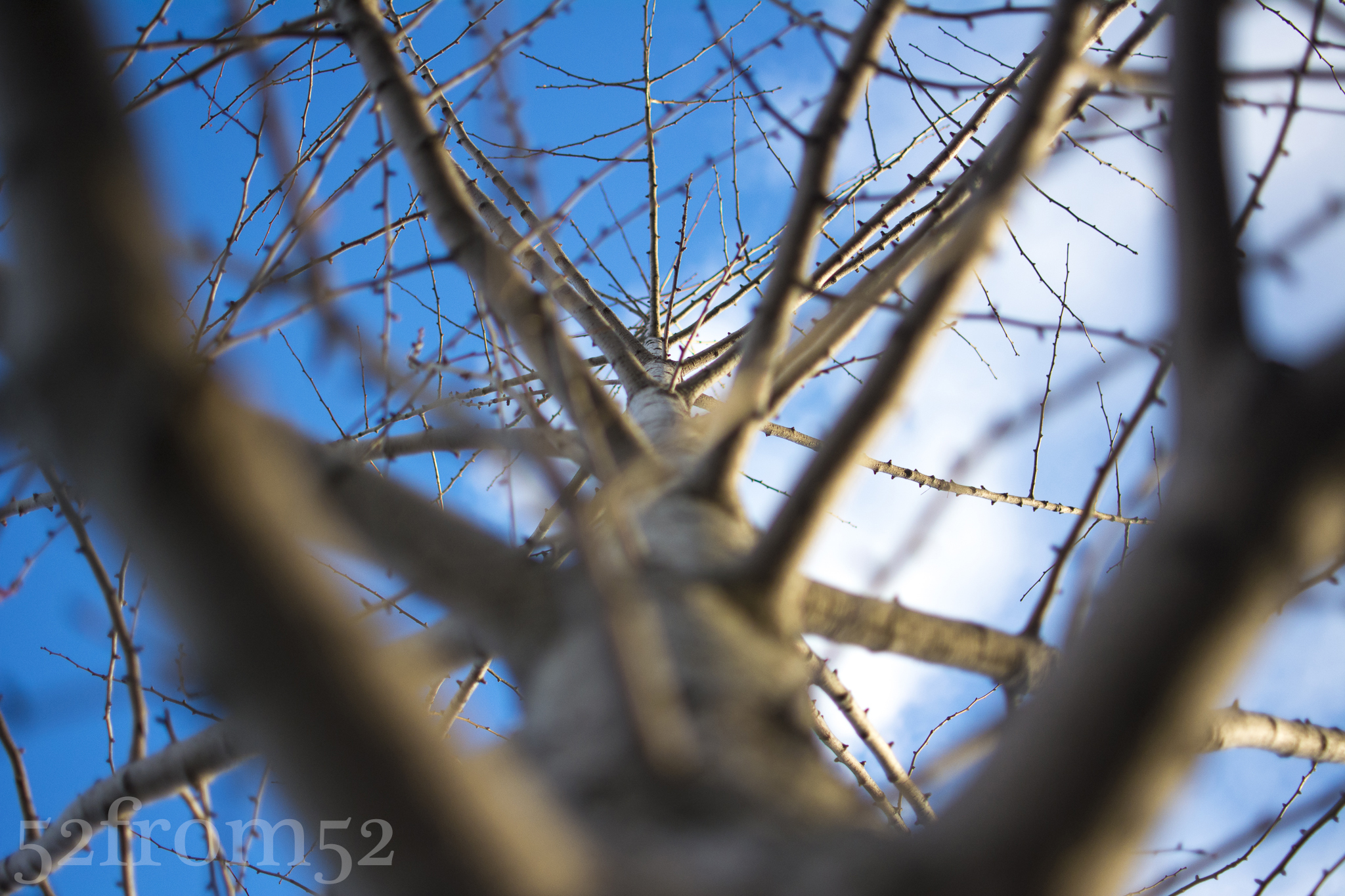
After my nice interaction with the old man I continued on my quest for this week’s picture.  I took pictures looking straight up trees, crouches at ground level, and I even fired off some no look shots while chasing some birds.  Although I might have looked like a real oddball to anyone that may have been observing, after they saw my pictures they would understand.  Eventually I worked my way back towards 4th street and the took one final detour at Pier C, or as I like to call it, Hoboken island.  I’ve attempted to get a picture from the winding entrance of Pier C many times.  This time I decided to drop to one knee and see what perspective that brought.  What I saw was how the railing of the path was leading directly towards the city skyline. I snapped of a couple pictures until homing in my settings then leaned directly against the railing for what would be my final picture.

Tree Perspective

Tree Perspective

Photography concepts:

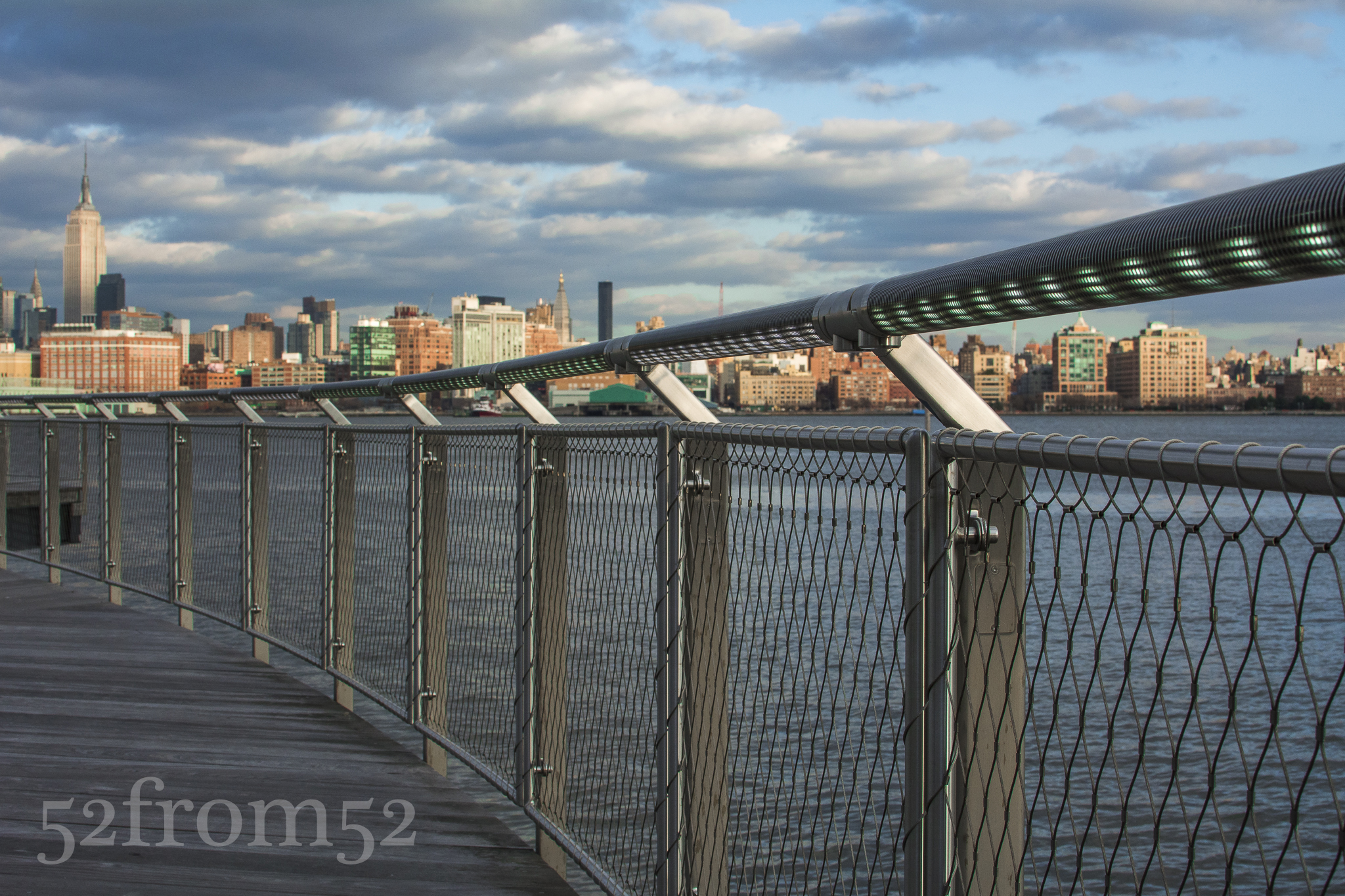
The focus of this week’s picture was finding a new perspective which essentially meant I needed to find a unique composition.  In this week’s picture the look that I was going for was one of a focus to blur effect on the railing that led to the city skyline.  To get this look I had to set my aperture not too small (f/22) nor too large (f/1.8).  A logical approach was to split the two numbers and that’s exactly what I did.  I shot my picture with an aperture of f/11 which usually puts mostly everything in focus but because I was so close (actually touching) the railing it gave a good blur to the city skyline.   Below is an example of how the closeness of the railing and use of focus points got me the “blur” look I was going for.  This picture is identical to my featured picture from a setting (ISO/aperture/shutter speed) standpoint but as you can see the skyline is a lot more in focus.  This is the picture that I think most people would take at this low angle.  I took this picture first, then to get a “new perspective” leaned into the pole to get a new spin on the view.

Picture Info: ISO 500, 35mm, f/11, 1/320 seco

Picture Info: ISO 500, 35mm, f/11, 1/320 seco

As I edited the picture in Lightroom, I wanted to emphasize the metallic look of the railing along with the lights that were built into it.  To do this I worked with the color sliders but unlike last week, I was actually adjusting the colors not black and white shading.  As a result of tweaking the green in the railing you’ll notice all the green in my picture really pops.  I wanted the green to stand out so it would first draw your eye to the railing then the green of the railing transitions into the green of the city skyline.

Overall lot of my “new perspective” shots involved getting lower to the ground or closer to my subjects than usual.  I encourage you to do the same with some of your pictures this week.  After you take a picture pause and ask yourself, without changing your subject how can you adjust your composition to get a new look?

Stone Cold

Picture Info: ISO 100, 35mm, f/5.6, 1/50sec

Picture Info: ISO 100, 35mm, f/5.6, 1/50sec

Week 22 (12/30/2013 – 1/5/2014): Prospect Park, Brooklyn NY

Picture taken on 1/4/2014 at 12:30 PM

Picture description:

This week as we rolled into 2014 and January, so rolled in the extremely cold weather.  On New Year’s day we were hit with a blizzard dubbed “Hercules,” which dumped a good amount of snow all over the east coast.  The news of the blizzard got me really excited to get out and shoot my first set of snow pictures with my Nikon.  Going into the weekend the plan was to explore Greenwood Cemetery with one of my friends that was out with me last week.  After receiving written permission to walk around the Cemetery, everything was a go, that is until the snow.  After the large snowstorm we were unsure how it would affect our plans, good or bad.  The night before our shoot we could do nothing more than hope we wouldn’t run into any issues and plan on ways to survive the cold.

The next day when we finally arrived at Greenwood we were greeted with a sign that said “gates closed due to inclement weather.”  Although we saw the sign we decided to try our luck by driving through the open gate.  Upon driving through the gate we were immediately stopped by a security guard that informed us the cemetery was closed until after 12PM.  Since we were working under some time restraints that wasn’t good news, so unfortunately we’d have to call an audible.

Luckily as it turns out prospect park was only about 5 minutes away from Greenwood, so we decided to give the park a go.  Even though we were two days removed from the storm, the streets were still covered with mounds of snow and it seemed nearly impossible to find parking.  When we were just about to give up, BINGO, we got a spot!  And so our snow picture quest began.

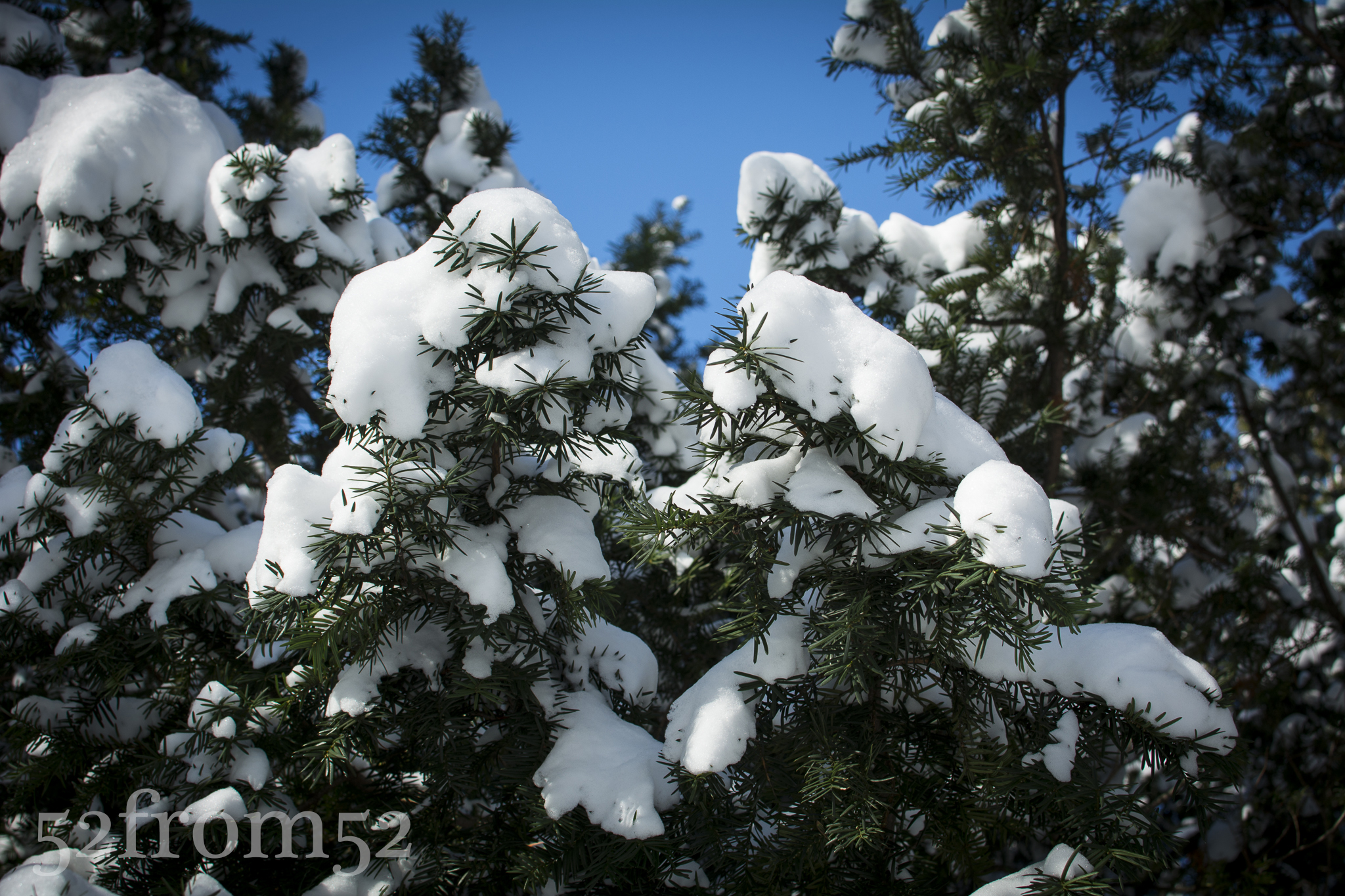
We entered the park at the South/West entrance which is guarded by two towering statues of men on horses.  Surrounding the gates were some interesting pine trees which were draped with loosely packed snow.  As we tried to take pictures under the trees we had to dodge random mini avalanches of snow falling from the trees.  Even though the trees offered plenty of good picture opportunities we decided to work our way into the park and double back later.

Pines at the gates

Pines at the gates

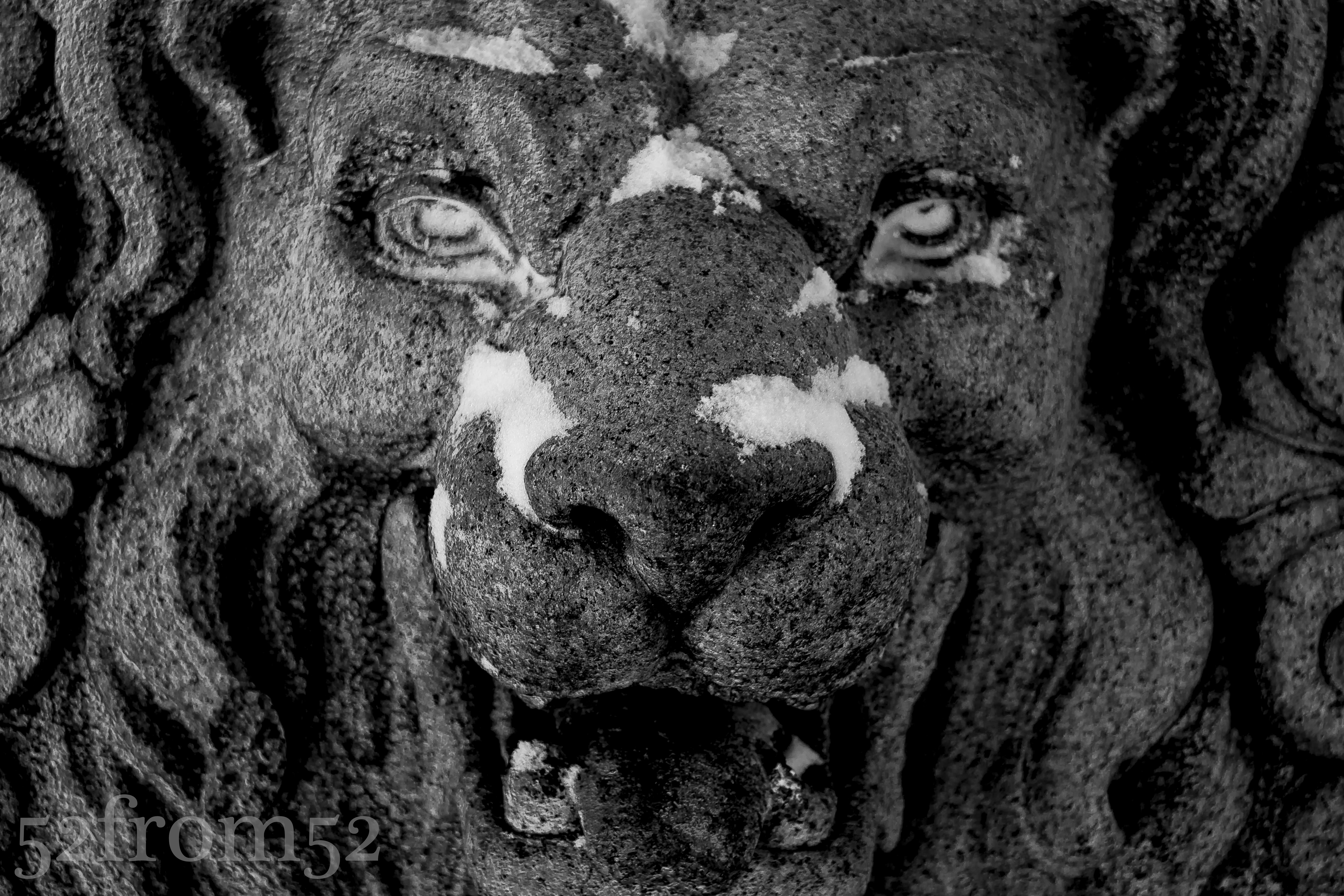
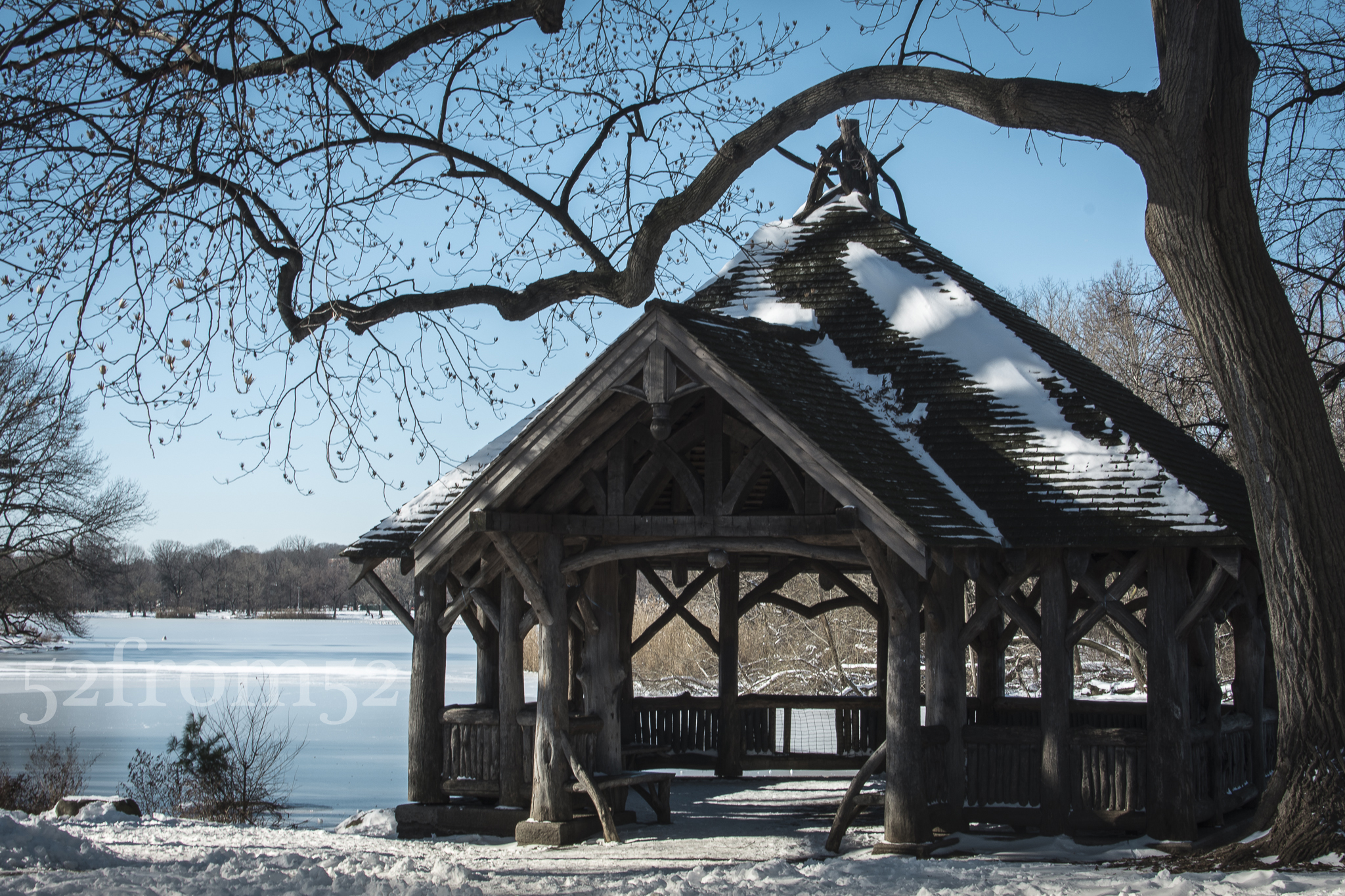
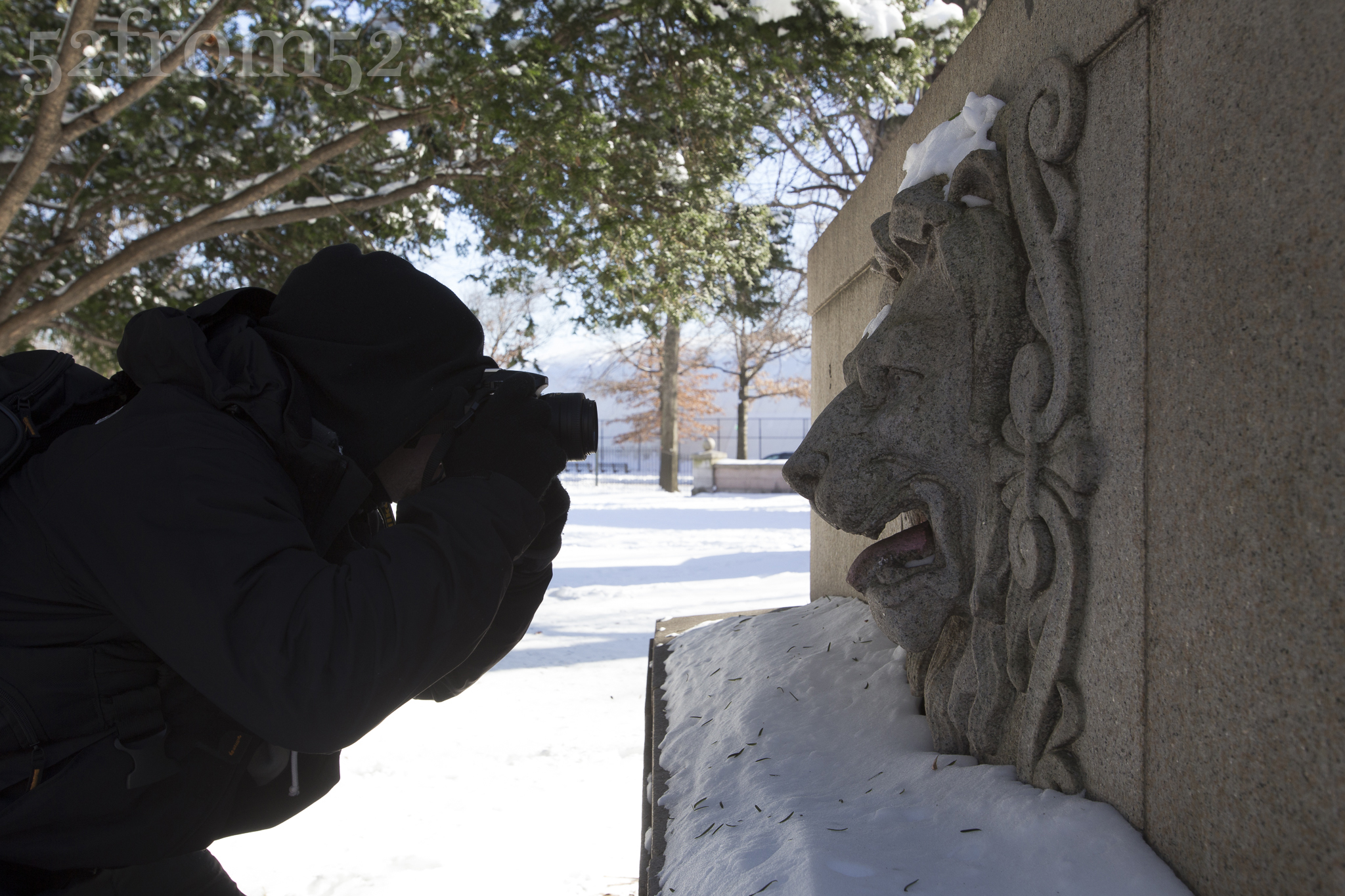
For about the next hour we worked our way East along the Southern perimeter of the park.  One of the most interesting parts of the trek was combing along the shore line of Prospect Park Lake.  The Lake was iced over and presented some temptation to venture out.  The temptation was cured after seeing “rescue ladders” which meant many have tried and failed.  I decided to steer clear yet at one point still almost managed to fall in.  As we reached the South/East corner of the park we spotted a gazebo built from logs that was nestled along the shore of the lake.  We stopped there for a while before working our way back to the main gates to end our trip.  Just as we were exiting the park I spotted this lion’s head that was built into the gates.  I shouted to my friend and said I had to get a picture of this.  As you may have guessed this is where I got this week’s picture and to date it might be my favorite picture from this blog.

Gazebo on the lake

Gazebo on the lake

Photography concepts:

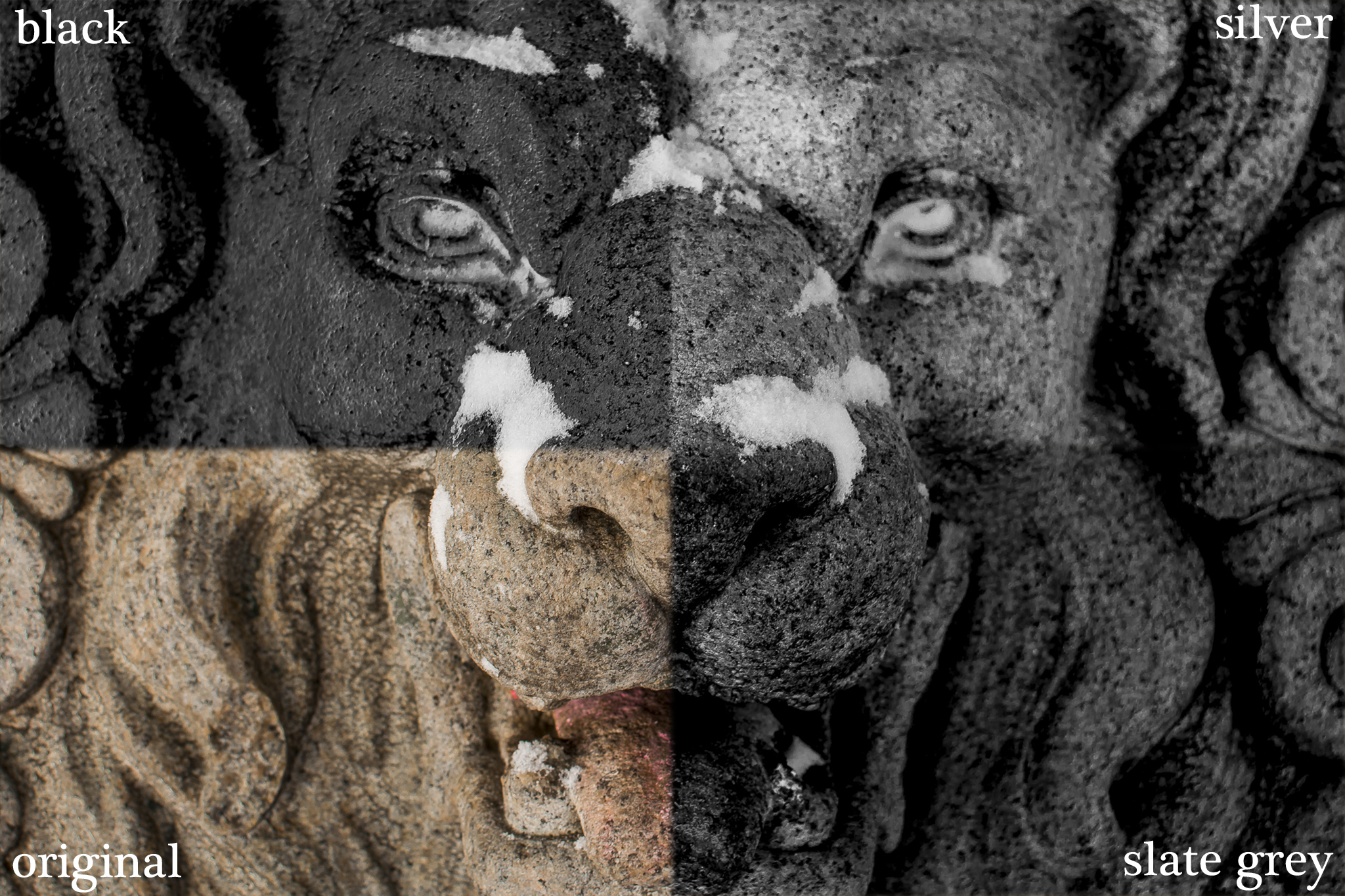
Throughout this week I’ve been experimenting with black and white pictures and the different editing techniques for them.  After watching some YouTube tutorials and doing my best to duplicate the editing in Lightroom, I’ve quickly realized how much fun black and white photography can be. After taking this week’s picture, although it looked perfectly good in color, I decided to flip it to black and white and see what happened.

Photo Credit; Roger Del Russo: www.delrusso.net

Photo Credit; Roger Del Russo: http://www.delrusso.net

I’m still very new to editing in black and white, but what I can already see as being the key are the different color sliders.  The color sliders allow you to focus in on colors such as Red, Orange, Yellow, Green, Aqua, Blue, Purple, and Magenta, and make adjustments.  Now you’re probably saying “wait isn’t this a black and white picture? Why would you adjust colors?”  Well, although it’s black and white the original picture’s colors are still part of the attributes and editable.  As you adjust the sliders you’re adjusting the levels of their representation in black and white.  In the case of this week’s picture I was able to blow out all the colors to make the lions face appear to be white/silver, or flip it to black.  In the end I decided to settle right in the middle and set the lion’s face to a grayish slate.  Focusing in on the colors is great because it allowed me to change the tint without losing the attributes of other colors such as the white.  I really like the contrast these sliders allowed me to create and I can’t wait to experiment with this more in the coming weeks.

wk22-lion-combo

If you’re new to this blog circle back and read some of my older posts.  In my earlier posts I’ve touched on subjects such as the rule of thirds, the triangle of photography and the different effects each point of the triangle (ISO/Aperture/Shutter speed) have on a photo.  As I’ve been progressing in my photography journey these are becoming more second nature and I’m beginning to focus more on editing techniques and changing the content that I shoot (people, close-ups, non-landscape).  I’m laying out some projects for 2014 so stay tuned and see what happens.

Sh-HOOT-ing with friends

Picture Info: ISO 100, 35mm, f/1.8, 1/1250 sec

Picture Info: ISO 100, 35mm, f/1.8, 1/1250 sec

Week 21 (12/23/2013 – 12/29/2013): DUMBO, Brooklyn

Picture taken on 12/28/2013 at 11AM

Picture Description:

Being an admitted cornball, I couldn’t pass up the opportunity to work “hoot” into this week’s title.  This Saturday marked the first time that I participated in what is often referred to as a “photowalk” in the photography world.  The idea was hatched by two of my friends, one a photography enthusiast like myself, and the other a professional photographer.  We kicked around some location ideas and eventually settled on DUMBO since it’s one of the more interesting and subject rich locations in the New York area.  DUMBO, located in Brooklyn, stands for Down Under the Manhattan Bridge Overpass.  Before Saturday I had never been to DUMBO so it was nice to finally cross it off my location bucket list. The area can get touristy not only because of the beautiful views but also because it’s home to the famous “Grimaldi’s Pizza”. Though not the original, there is a Grimaldi’s located in Hoboken so standing in line for pizza was not part of Saturday’s agenda.

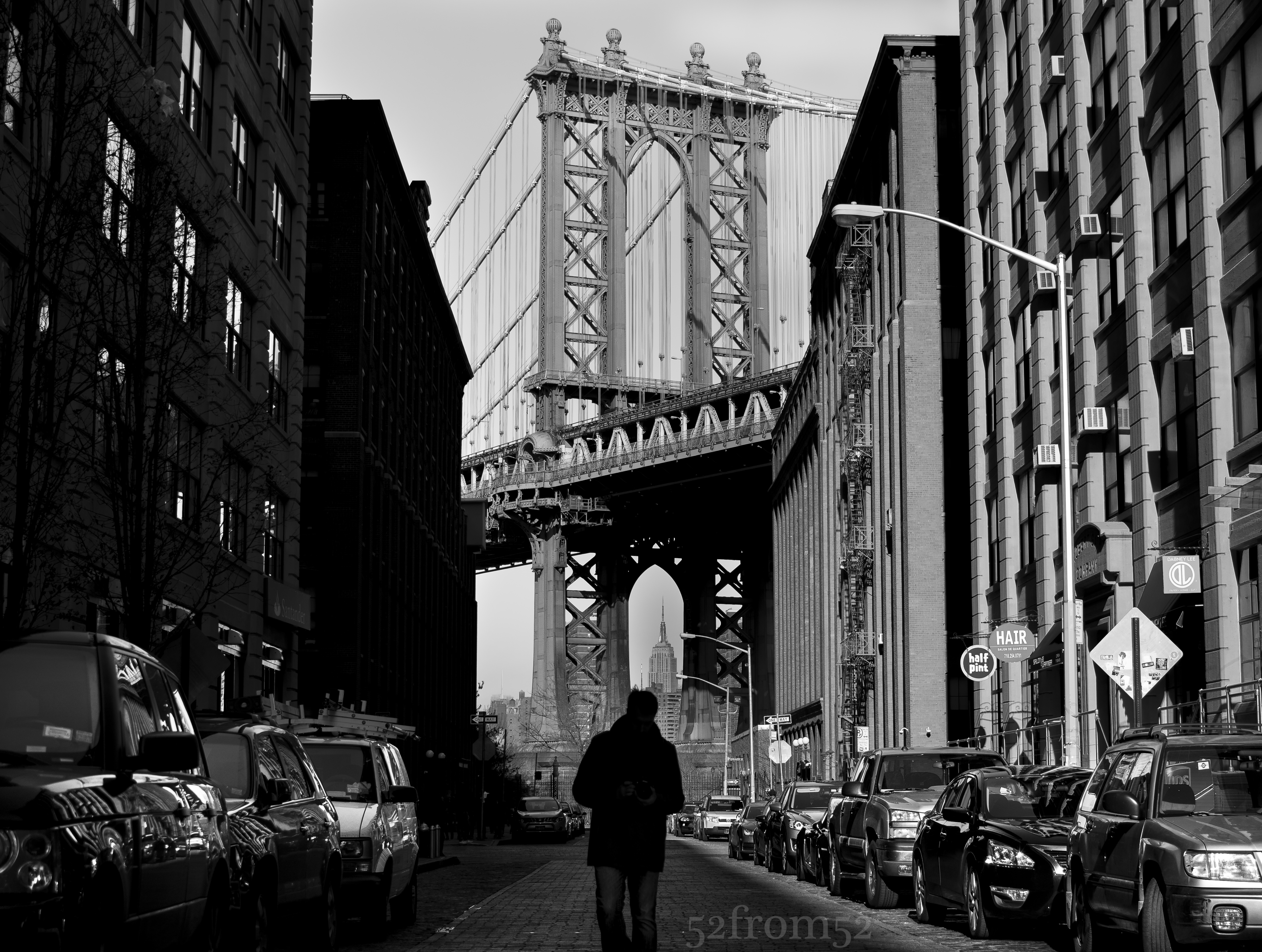
DUMBO Classic Picture

Classic DUMBO Picture

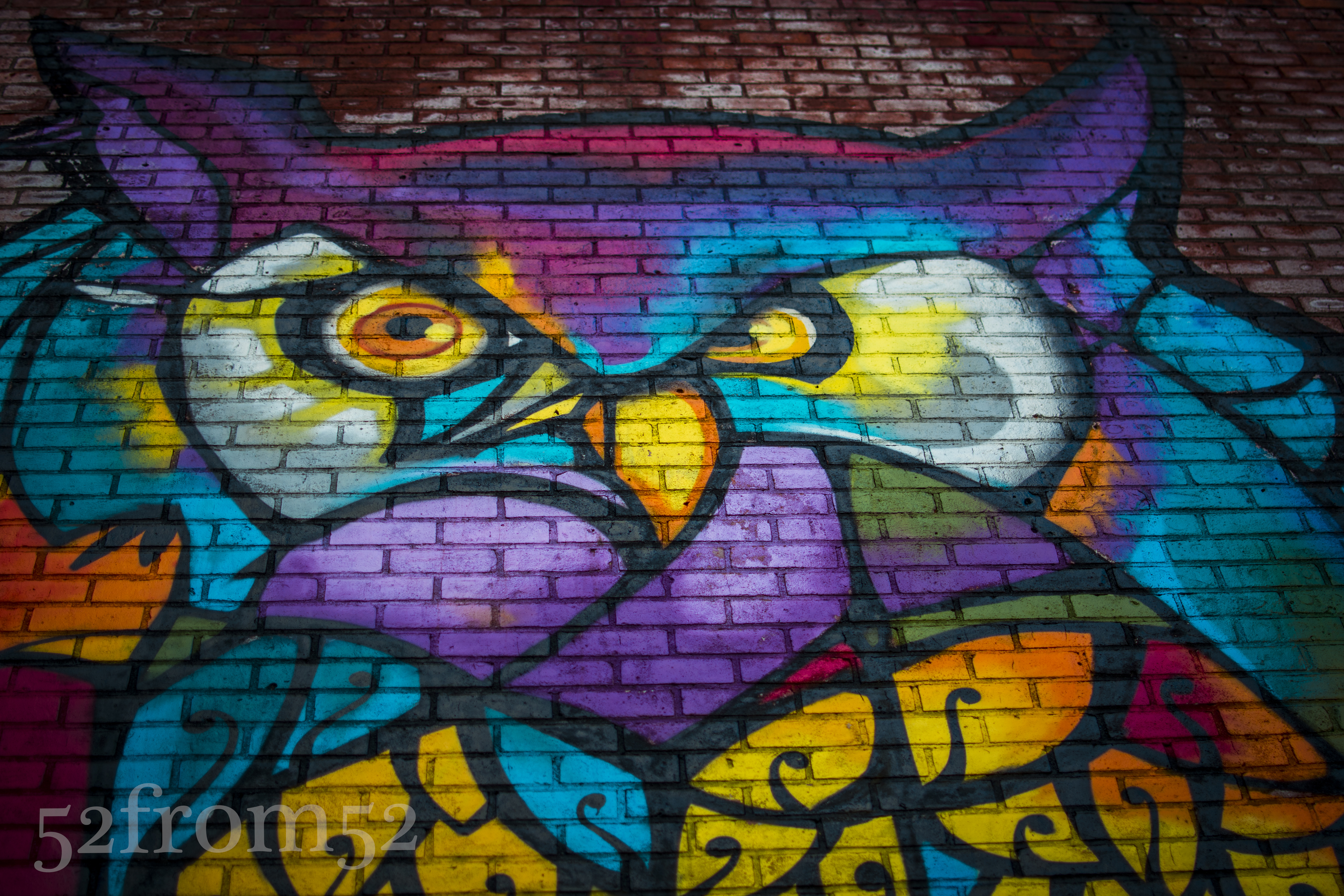
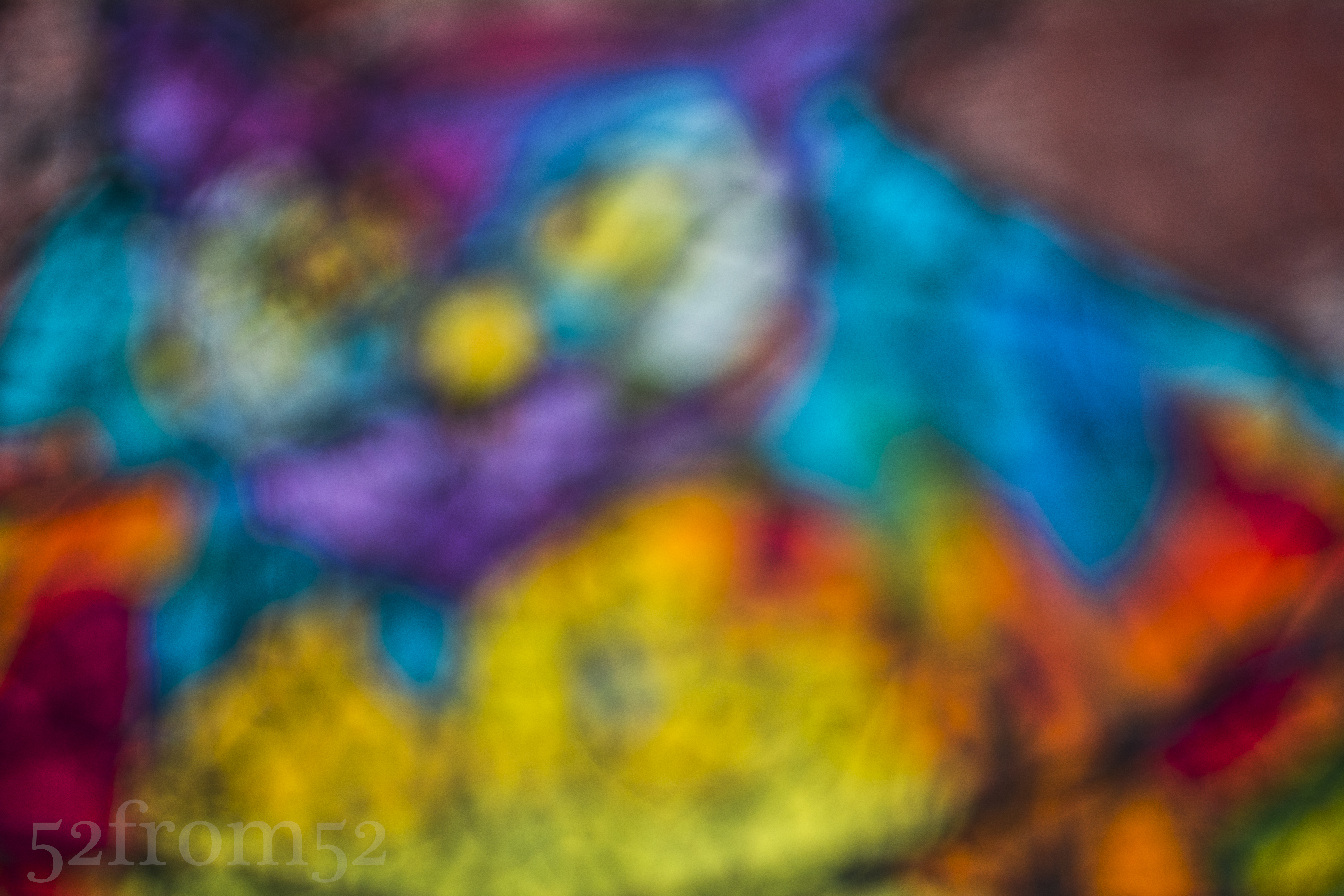
Shortly after arriving on location I spotted what I consider to be the classic DUMBO picture.  Although I didn’t want to use this as my featured picture, I couldn’t pass up the opportunity to take the shot.  We spent the morning walking around discussing different techniques, equipment and comparing pictures.  After walking around the east river’s shore line we decided to head into the streets to see if we could find some lunch and perhaps some graffiti.  Post lunch we stumbling upon the brick wall that contained this weeks picture.  All three of us worked the wall individually to find what we thought would be the best way to photograph it.  It was interesting seeing how other photographers approached shooting the same subject and how each of us had our own unique view.  After a few minutes of working on our own we compared pictures and tried our hand at duplicating each others shots. We continued doing this for a little while then eventually decided to call it a day.  While driving back to New York City we came to the conclusion that this shouldn’t be our first and only photowalk.  In the coming week’s expect more posts chronicling different “photowalks” and if you’re interested in participating in one shoot me an email.

Bokeh Owl Version

Bokeh Owl Version

Photography Concepts:

This week I learned less from my own shooting and more from the discussions and tips that were traded during the photowalk.  One of the biggest takeaways, which might come as a surprise to anyone familiar with photography, was the concept of spot metering.  Prior to this weekend I heard the term before but never really understood what it meant or where it would be applicable.  In a nutshell spot metering allows you to lock in the exposure you want then recompose and shoot your picture.  I didn’t get any good photo example  for spot metering this weekend but you can bet I’ll be experimenting more with this in the future and do a post on it.

Another subject that came up worth noting was white balance and the importance of doing it in camera.  I always thought that I could do white balancing during editing and there was minimal to no trade offs.  This however was not entirely true.  Essentially although you can fix white balance after shooting, by getting the correct white balance in camera I’ll have more flexibility in editing later.  I mainly shoot landscape and outdoors pictures, so luckily white balance hasn’t come into play that much for me thus far.  In 2014 my goal is to take more pictures of people so expect more posts on white balancing now that the subject is a lot less murky.

On the run

Picture specs: ISO 640, 35mm, f/8, 1/15 sec

Picture specs: ISO 640, 35mm, f/8, 1/15 sec

Week 13 (10/27/2013 – 11/2/2013): Maxwell Place Park, Hoboken NJ
Picture taken on 11/1/2013 at 5:59 PM

Picture description:

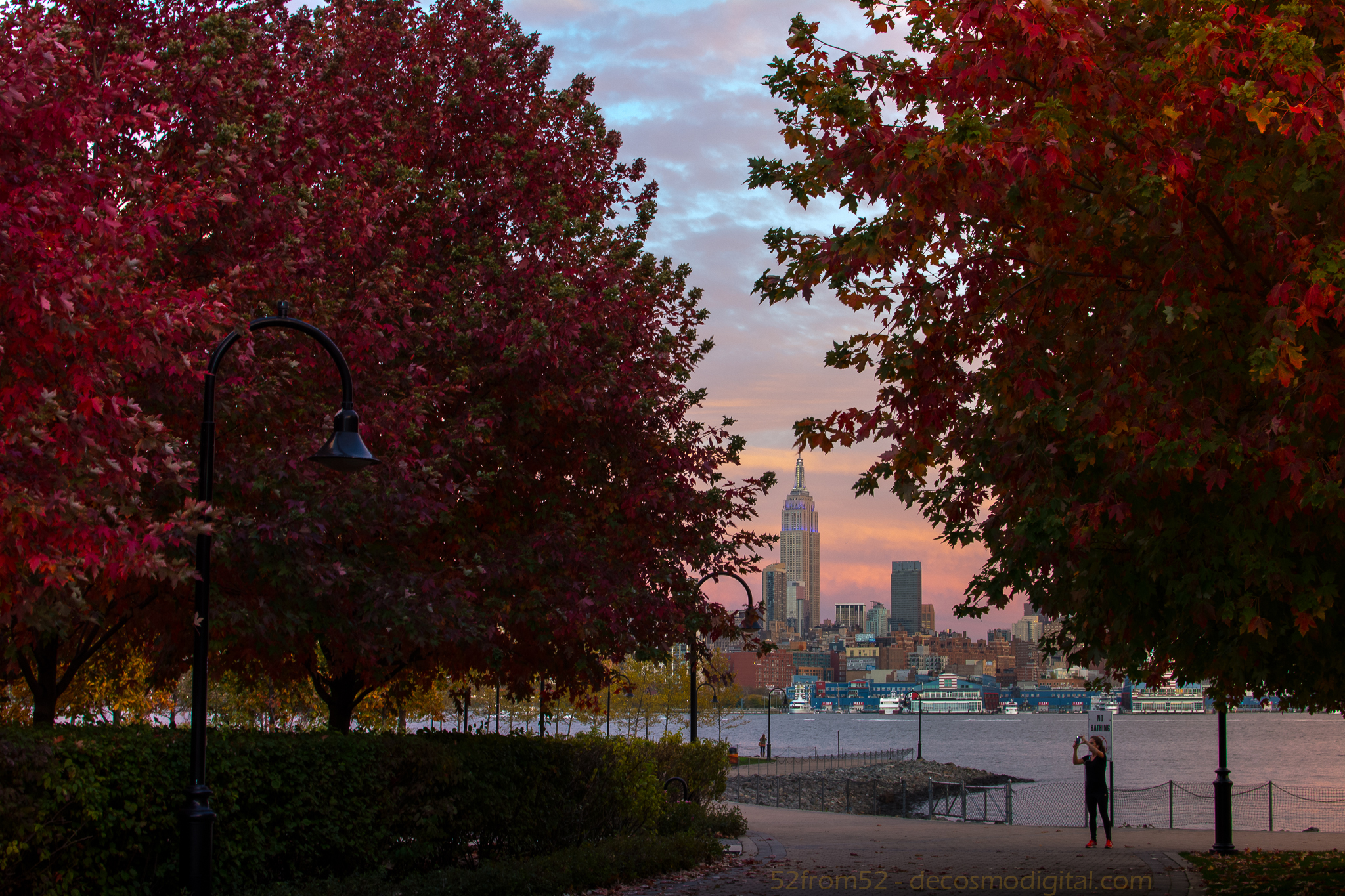
One of the many benefits of living in Hoboken is having easy access to its waterfront parks and paths.  The waterfront provides a place to relax, socialize and or exercise in the midst of some beautiful views.  If I had to point out one negative aspect about exercising on the waterfront, it would be that while running you regularly have to fight the urge to stop and take pictures.  If you follow my Instagram you’ll probably notice most times this is a losing battle for me.  This week I decided to take my Nikon out during the time I usually run to see if I could capture something that depicts my daily struggle.

While moseying around Maxwell Park I noticed that many of the trees that were green just last week were now turning all different kinds of amazing colors.  There were two trees that really stood out to me so I began trying to find a good angle to photograph them.  As I shuffled around the trees I noticed that I wasn’t the only one that was giving them focused attention.  Runner after runner stopped to fire off a picture “on the run” then carried on their way.  Initially having runners photobomb my picture was very frustrating until it hit me, this is exactly what I do, so why not try to capture the moment?

Photography concepts:

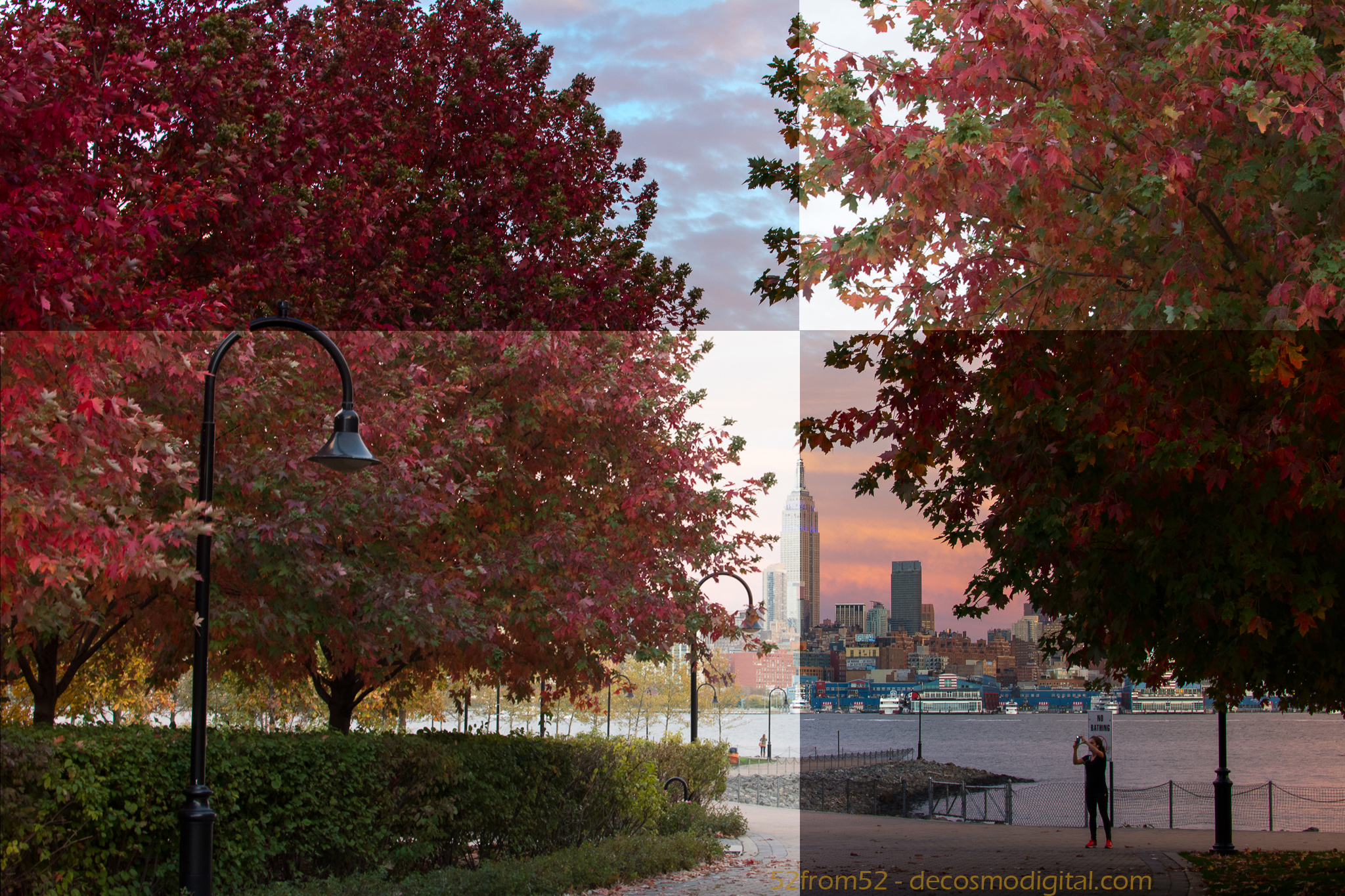
This week’s photo included a wide range of colors most of which required different exposure settings to reveal their vividness.  The best tactic that I’ve found for recovering color when you can’t choose one exposure is via select post-production exposure adjustments.  Although it’s possible to recover many colors after the fact you still have to select an in camera exposure which isn’t going to make that impossible.  What I’ve found through experience and also read is that going with an underexposed picture allows for more recovery capabilities.  Despite my own observation regarding underexposing, this week I rolled the dice and didn’t drop the exposure of my picture.  To demonstrate what I’m talking about regarding exposure recovery I sliced up before and after sections of my picture to highlight the comparison.  The most noticeable area that benefited from the exposure adjustment was the sky and empire state building.  Without making the adjustments illustrated below the tree’s would have still had nice color but the entire sky would have been very washed out.

Half edited

Edited vs. Unedited example

In addition to having the right in camera exposure settings the other key setting which permits recovery capabilities is shooting in your camera’s RAW mode.  For Nikon the raw mode is NEF format and it retains 12-14 bit data versus in JPEG where it retains only 8 bits.  To read more about Nikon’s RAW format see the article linked below.  Although each camera brand has it’s own RAW mode it’s fair to say that each would follow similar attributes and recovery capabilities.  When I first started taking picture with my 5200 I went with just JPEG then after learning the value of RAW I did JPEG + RAW.  Now to save space I only shoot in RAW format which still takes up a lot of space.  So far the space limitation is one of the only negative that I’ve run into in regards to shooting in RAW mode.  My 32GB card can hold about 875 NAF images while I can shoot 2000+ JPEG (fine) images.  The other negative aspect of shooting in RAW is that there are some limitations on what you can use the edit the image.  I recently found out that you can edit RAW images via Google+ and Snapseed which is really great for on the go editing.  If you want to learn more about Google+ editing watch the below YouTube video from one of my favorite online photography resources “Camera Rec Toby”.  If you have time I highly recommend clicking through Toby’s YouTube page, he is very informative.

NIkon NEF Article

Night Light

ISO 100, 35mm, f/8.0, 4 sec

ISO 100, 35mm, f/8.0, 4 sec

Week 6 (9/8/2013 – 9/14/2013): Shipyard Marina, Hoboken NJ
Picture Taken on 9/9/2013 9:11PM

Picture Description

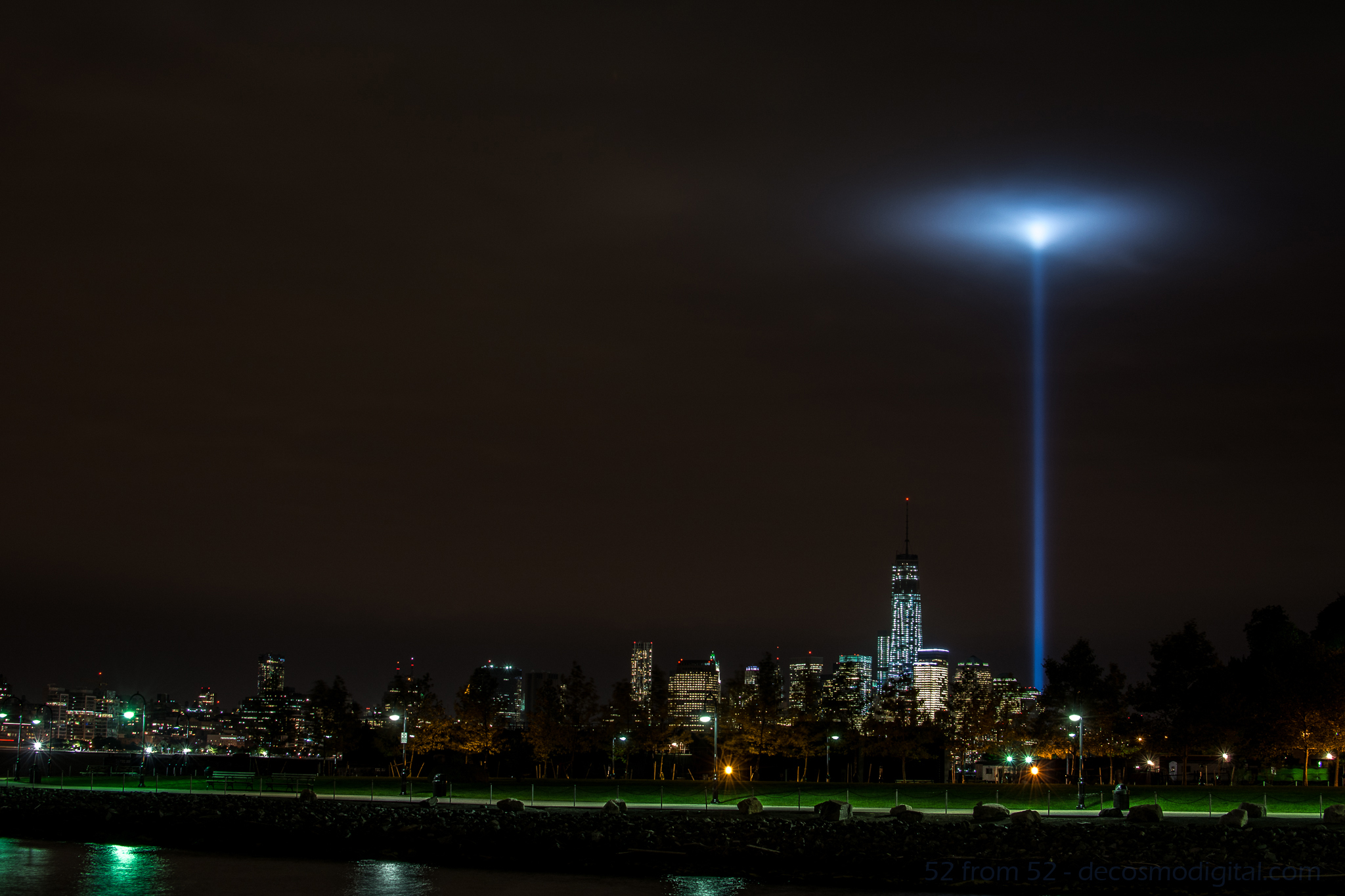
Going into this week my goal was to create a multiple exposure photograph or light trail night picture.  As a possible secondary option I bookmarked the possibility of photographing the freedom tower.  On Monday night I went out around 6ish to mess around with my new Nikon ML-L3 remote.  I was aiming for either a double/triple exposure of the Hoboken ferry or some kind of sunset shot.   After messing around for about an hour I went back to my apartment to eat some dinner, review my pictures, and wait until the sun was totally down so I could try for a night picture.  Unfortunately after reviewing the pictures on my computer none of them worked out as I planned so I was going to have to go back out for the night shot.

After dinner as I stepped outside of my apartment my eyes were instantly drawn to the distant southeastern skyline.   What I was looking at was simply amazing, the 9/11 memorial lights were getting trapped in some low thick clouds and forming this surreal spherical glow.  All of my other night picture plans went out the window at that point, I had to take a picture of this unique occurrence.

After taking the picture I thought it was good (not great) but didn’t want to use it as my picture for this week.  As I do with most unused pictures I posted it up on Facebook to share with my friends.  To my surprise this picture got more activity than any other one I’ve posted.  Coming up with a picture to top this one, at least this week would have been hard so in the end I decided to use this picture.

 Photography Concepts 

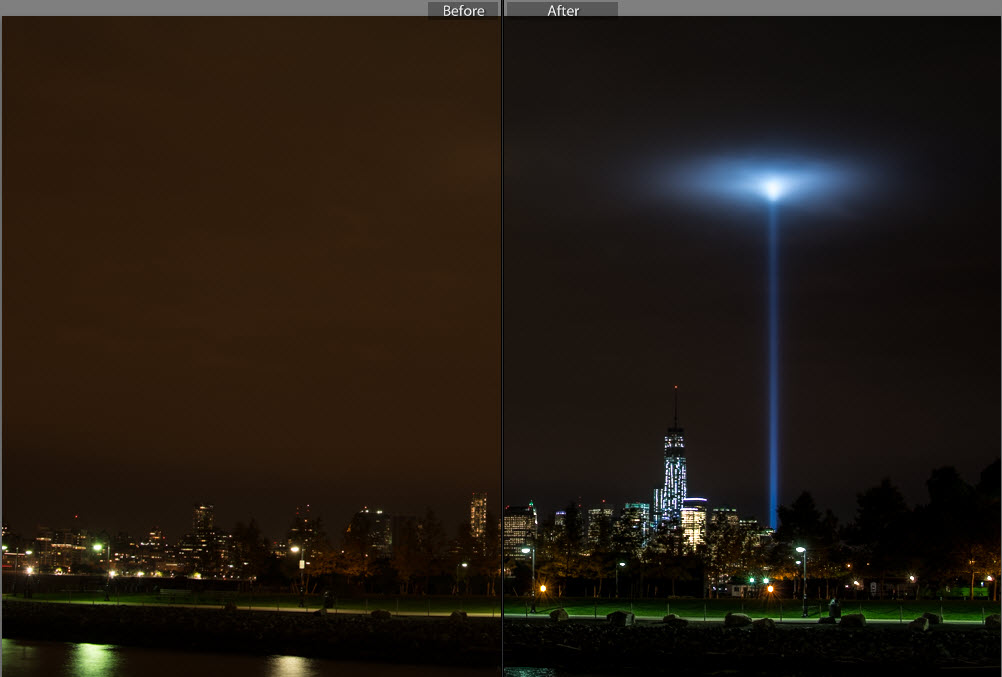
To get this picture I had to apply many of the tricks I’ve learned over the past couple of months. In some of my previous long exposure pictures I noticed a slight camera shake.  To prevent getting shaky images I’ve moved towards using either a 2 second delayed shutter release or in this case a remote.  Next I regularly use a UV filter on all my camera lens to prevent any wear and tear.  Over time I noticed that at night using a filter increases the amount of light distortion and bleed, so prior to this picture I removed the UV filter.  The last two keys to this photo, which I’ll talk about in a little more detail, are the exposure settings I used and editing in Lightroom.

The exposure I used was -2 (stops) which for anyone that doesn’t know, it’s an underexposure.  The reason I underexposed was because after taking other nighttime city shot I’ve noticed that with so many lights from all the buildings my pictures tend to get overexposed.  There are lots of negatives with overexposing, in terms of my city pictures the most noticeable is the change in the sky color.  After messing around with different exposures I’ve settled on -2 for my go to exposure setting.

Now it’s hard to describe all the different tweaking I did in Lightroom but one of the main fixes was the white balance setting.  I forgot my white balance cards when I went out to shoot this picture so I had to do it after the fact.  I also made some moderate adjustments to the Highlights, shadows, whites, blacks and clarity to get the picture to look like what I saw in person.  If you want to learn about Lightroom I highly recommend going on youtube and watching some tutorial videos.  There is so much information out there to support learning photography (and most other hobbies) it’s just about finding it.

Before and After Editing in Lightroom

Before and After Editing in Lightroom

Since I originally did not want to use this picture let me quickly explain why and what I could have done better.  For starters if I remembered my white balance cards I would not of had to do so much editing in Lightroom.  I rather get a good picture in camera rather than edit it especially for this photoblog. I also wasn’t happy about my composition, the green in the picture is really nice but I was made I cut off some of the left side of the peninsula that is shipyard park.  I wish that I would have stepped back another 30-50 ft to get more into the picture.  Last I wish I found something interesting to put into the foreground of the picture, it just makes for a more interesting picture.

Article about Exposure
http://bit.ly/1eOEzt8

Lightroom Video’s
http://bit.ly/140WqbT
http://bit.ly/1ddxPTS