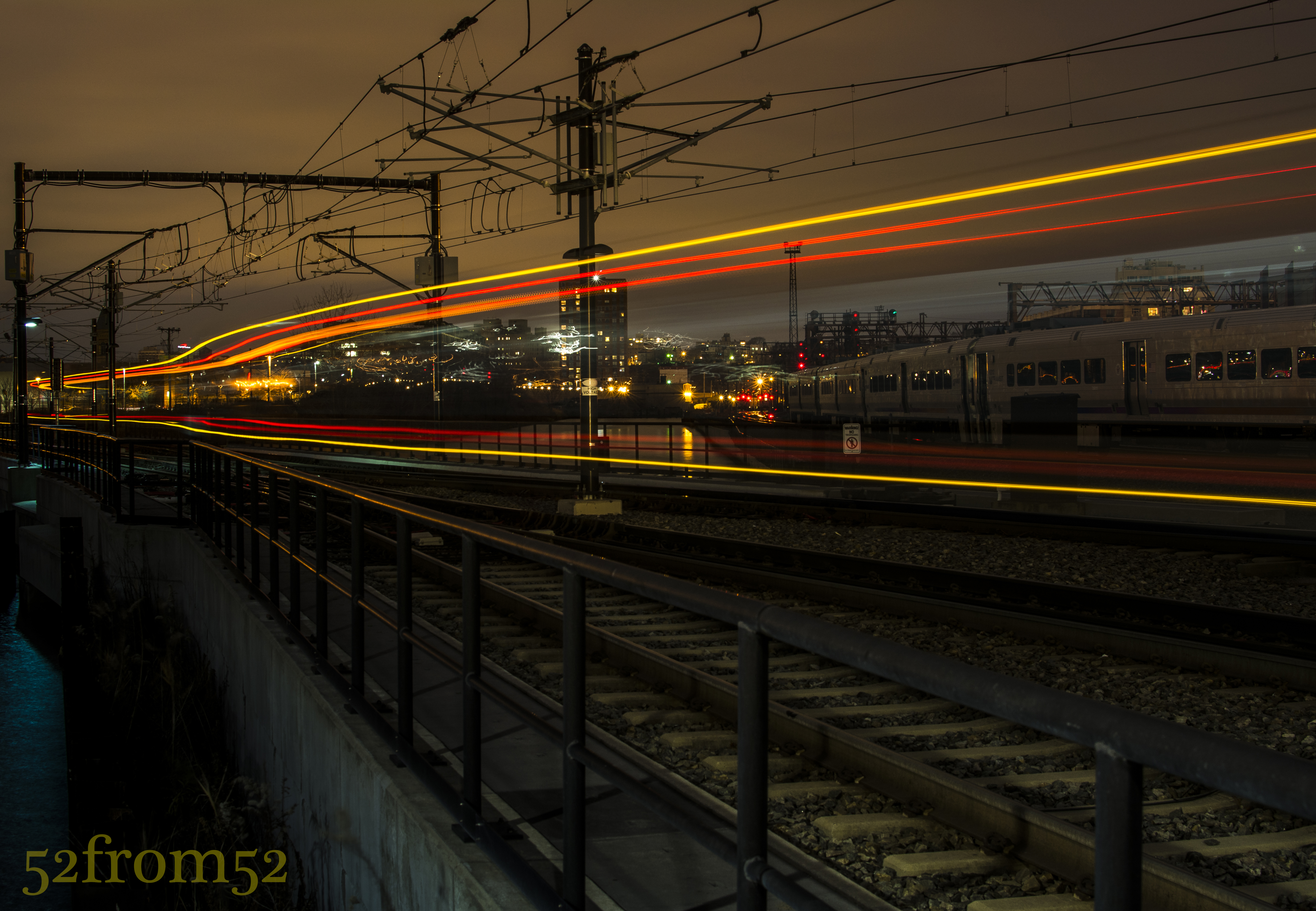
One shot

Picture info: ISO 100, 35mm, f/9, 30seconds, 0.6 neutral density filter, -2 exposure stops

Picture info: ISO 100, 35mm, f/9, 30sec, 0.6 neutral density filter, -2 exposure stops

Week 17 (11/25/2013 – 12/1/2013): Hoboken Light Rail Station
Picture taken on 11/30/2013 at 5:12 PM

Picture description:

Opportunities come and go, and sometimes you only have one shot to take advantage of them.  That was absolutely the case for my week 17 picture.   This week I picked up some neutral density filters (I’ll explain what these are in the concepts section) which I wanted to experiment with.  Coming into the week my goal was to venture into the city to get some kind of street shot/long exposure.   When it came time to go out and shoot on Saturday I was a bit demotivated due to two things. First it was really cold outside, and the second reason was because of the conflicting online posts about wether or not it’s okay to use a tripod in New York City. Since I wasn’t in the mood to argue my way out of a ticket I decided to play it safe and set out for an area in Hoboken that I have been meaning to photograph for a while.

The location I chose for this week’s shoot was a walkway between the Hoboken train station and Newport, Jersey City.  I’ve seen some really nice pictures on Flickr that were taken from this seemingly hidden location.  Many of the pictures featured old dock posts of a broken down pier with either the Jersey City or New York city skylines in the background.  With a couple clear pictures in mind I set up my tripod and started taking some long exposures.

After spending about 2 hours taking long exposures and chasing lots of seagulls I decided to call it a night.  As I started to pack up my gear I spotted a potential picture which would feature the light-rail train as it left the station.  I figured why not give it a shot?  I quickly set up my tripod on the edge of the tracks in preparation for the next train.  The trains were coming about every 30 minutes, so unless I wanted to wait out in the cold for the next one, I’d have only one shot at capturing a good picture.  From the distance I heard the bell sound announcing the train’s pending departure, I quickly clicked my camera’s shutter release, sat back and watched as the light-rail moved in and out of the frame.   After what seemed like an eternity, but really was only 30 seconds, my camera finished taking the picture and I eagerly awaited seeing what it captured.  Once the preview came up on the screen I immediately knew this was the picture I had to feature in this week’s post.

Photography concepts:

This is the second “long exposure” post that I’ve done, the first being my week 6 picture “Night Light.”  Since week 6 I’ve learned some new tricks for taking and editing long exposure pictures.  As I am becoming better from past lessons, I’m able to add more moving parts and that’s what spurred on this week’s experiment with neutral density filters.

Neutral density filters, commonly called ND filters are pieces of glass that come in many shapes and sizes but ultimately block light from hitting your camera’s sensor.  As I mentioned in this weeks description, my goal for the week was to get a long exposure but you don’t need an ND filter to do this.  Although ND filter’s are not required for all long exposures, they are if you want to take a long exposure during the day or anytime there are bright light sources.  With the use of ND filters you’re able to use settings that would usually not be feasible in certain conditions or due to other selected camera settings such as wide apertures. Usually when you use slow shutter speeds (20-30 second) you have to shrink your aperture to f/13-f/20 to limit the amount of light.  f/13 isn’t bad but once you start approaching f/20 pictures lose their crispness, this is where the ND filters come in handy.  Take the below picture for example.  The sun was setting behind the buildings and flooding my camera’s sensor with light.  Given the amount of light, and having already maxed out at the smallest aperture my lens can shoot with (f/20), I would usually only be able to use a fast shutter.  With the use of the ND filters I was able to shoot with a 4 second shutter speed.  For the below picture I used a combination of ND filters which totaled out at a 2.7  density rating,  which is equivalent to -9 exposure stops.
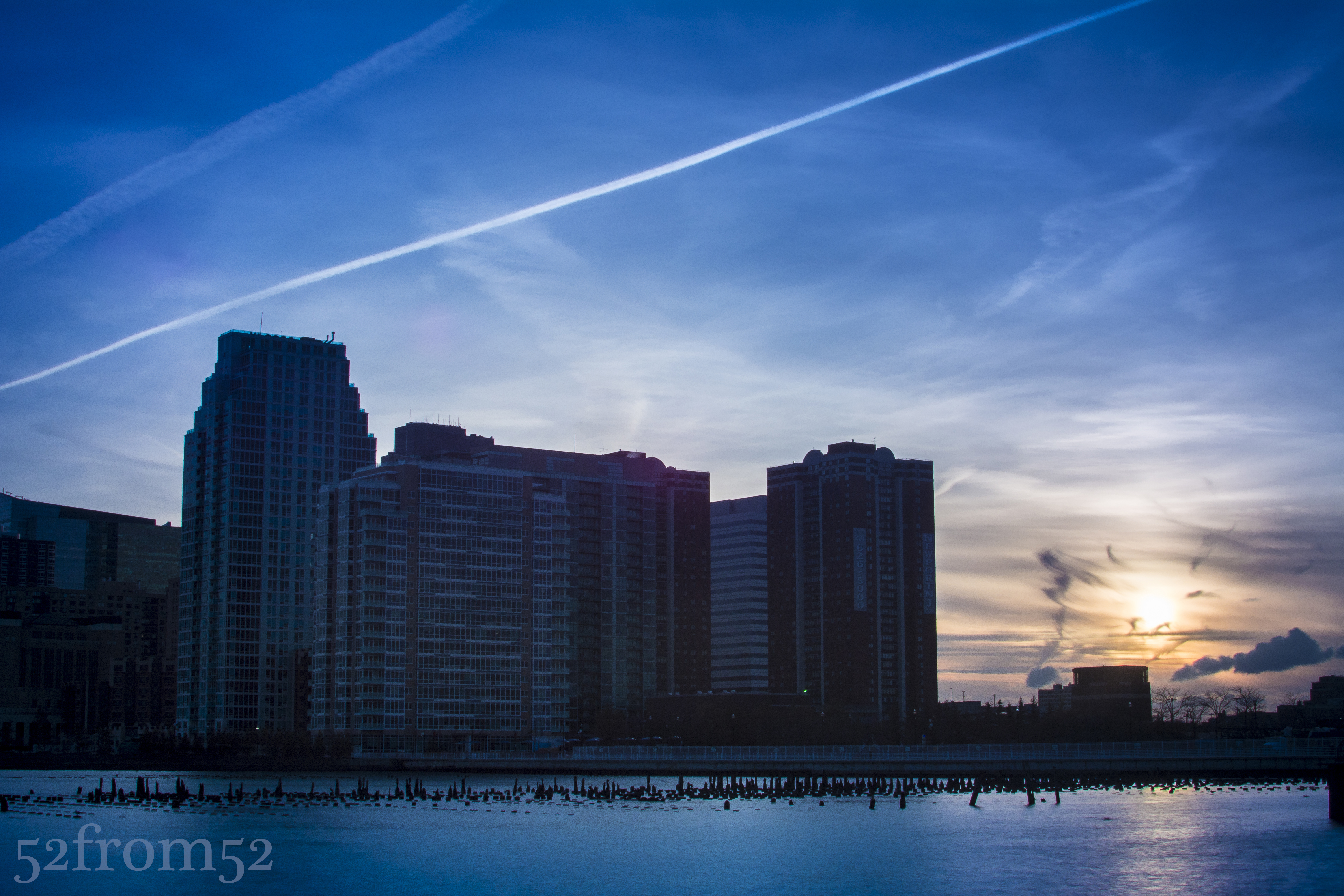
Picture info: ISO 100, 35mm, f/20, 4 seconds, 2.7 ND filter, -2 exposure stops

Picture info: ISO 100, 35mm, f/20, 4 sec, 2.7 ND filter, -2 exposure stops

Now you’re probably asking why would you want to do a long exposure for a picture such as this, and what are the effects? One reason/effect is the smooth and very reflective water.  Notice how the water has begun to almost look like ice in the above picture.  The smoothing effect is even more prevalent in the below picture where I used a 30 second exposure and a 0.6 ND filter.
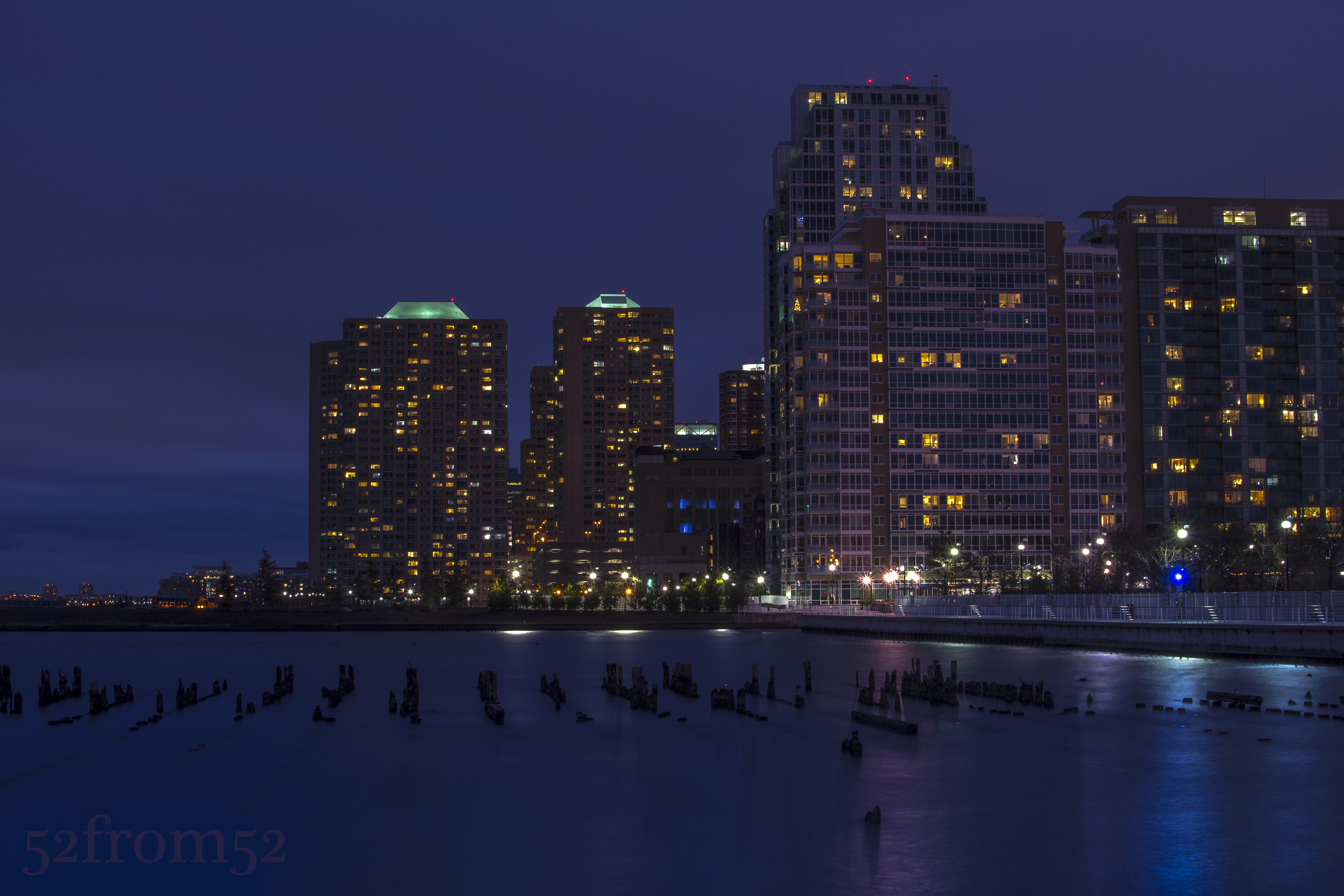
picture info: ISO 100, 35mm, f/14, 30 seconds, 0.6 ND filter, -2 exposure stops

Picture info: ISO 100, 35mm, f/14, 30 sec, 0.6 ND filter, -2 exposure stops

All this being said, how did the ND filter help me with this week’s picture? In order for me to capture the train’s full movement from right to left I needed to use a 30 second shutter speed.  As mentioned in previous blogs, night pictures look better when under exposed but even with dropping the exposure down 2 stops I still wasn’t able to hit the 30 second shutter speed mark.  Add in the fact that once the train passed by my camera’s sensor was going to get a burst of light it was very important to somehow compensate.  I didn’t want to shoot with too small of an aperture so here is where the ND filter came in.  I used a 0.6 ND filter which is equivalent to -2 exposure stops, this allowed me to maintain a good night exposure, use an aperture of f/9 and hit my 30 second shutter speed.  The result of the 30 second exposure was the very vivid light trail that’s featured in this week’s picture.  This was my first time experimenting with the ND filters so expect some more pictures and feedback in some coming blogs.  For more info on ND filters check out the below link.
http://www.digitalcameraworld.com/2012/07/05/how-and-when-to-use-nd-filters-and-what-the-numbers-mean/

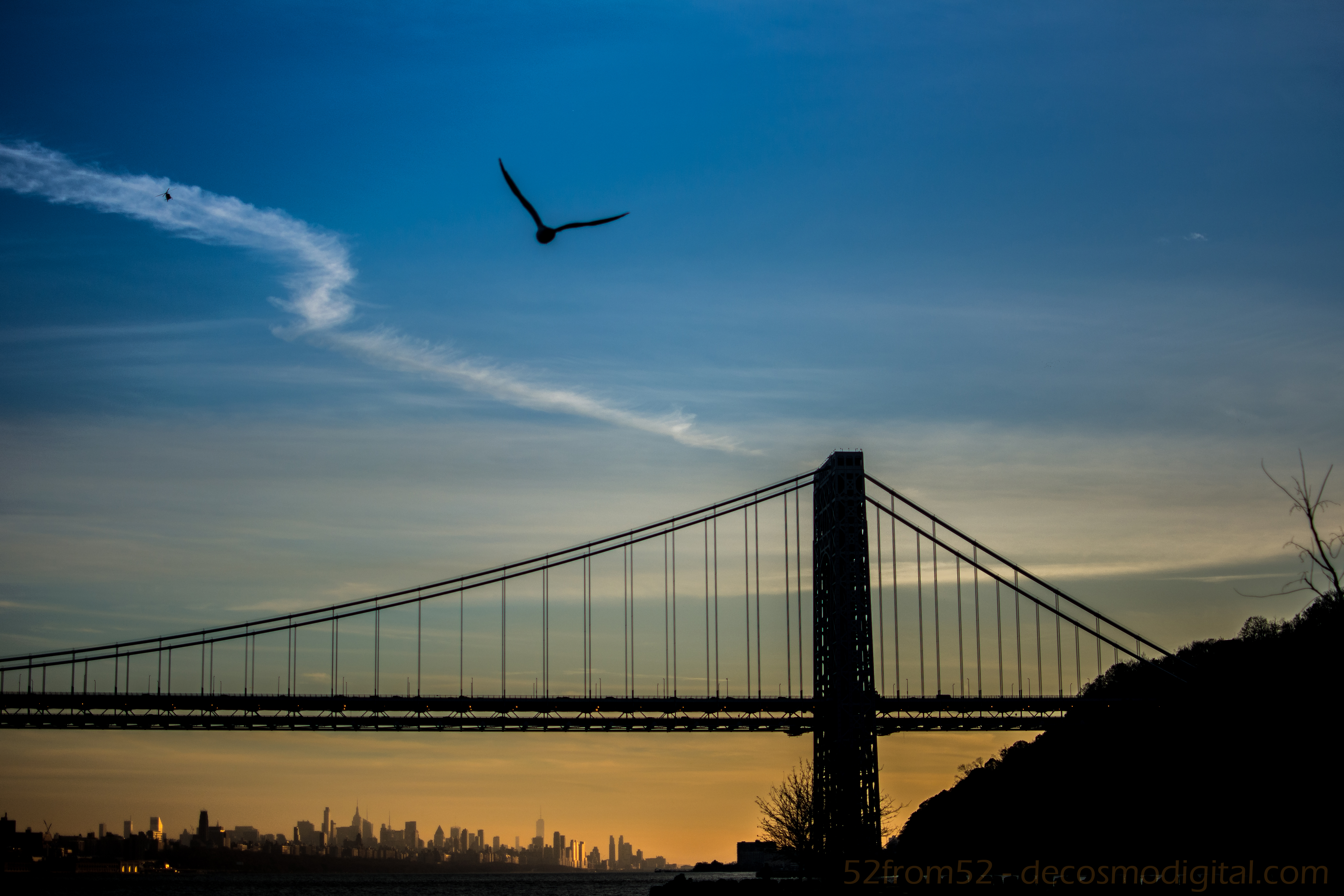
Need for Speed

Picture Specs: ISO 200, 35mm, f/1.8, 1/4000sec

Picture Specs: ISO 200, 35mm, f/1.8, 1/4000sec

Week 15 (11/11/2013 – 11/17/2013): Palisades interstate park
Picture taken on 11/16/2013 at 5:20 PM

Picture description:

This week’s photo was captured at the Palisades Interstate Park, a place that I haven’t been to since I was a kid.  If you’ve never gone I highly recommend spending the day exploring all that the park has to offer.  The park is nestled on the palisades cliffs which are both beautiful and dangerous so mind the paths.  Jutting out from the cliffs is none other than the iconic George Washington Bridge which is always a sight for sore eyes, granted you’re not stuck in traffic on it.  To add to the parks beauty when you’re north of the bridge you have a sprawling view of the Manhattan island coastline aka New York City.

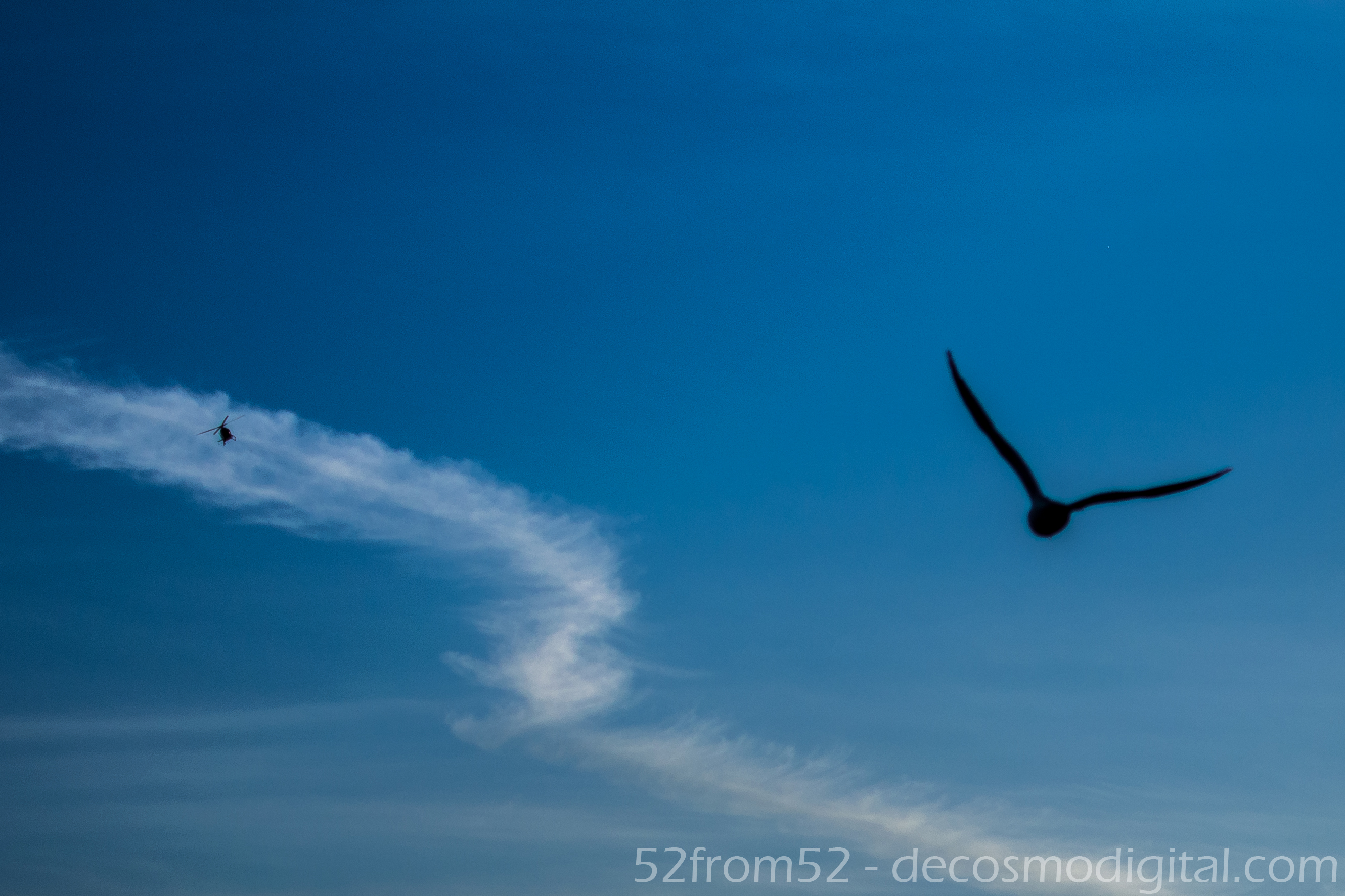
Helicopter Vs Seagull Joust

Helicopter Vs Seagull Joust

While walking around the park there were two things buzzing around the sky that kept grabbing my attention.  One was a pair of helicopters which were doing fly bys of the bridge, my guess is they were filming for either a TV show or movie.  The second airborne thing that I couldn’t help but notice was all of the seagulls flying around.  At one point I was able to creep up within inches of one seagull that seemed to like the lime light of my camera.  Unfortunately my Dr. Doolittle moment was spoiled when a couple of rude people crashed my photoshoot, naturally scaring away the Zoolander of seagulls.  Luckily this forced me to move locations which is where I stumbled upon a big flock of birds that kept doing take off runs towards the bridge.  While one bird launch from the cliffs he seemingly locked into an aerial joust with one of the helicopters.  It might be a little hard to see at your first glance but if you look at this week’s picture close enough you’ll see the helicopter’s silhouette in the top left.  At the time of the picture I wasn’t sure if I actually caught this freeze frame but I was pleasantly surprised when I found it during editing.  Capturing this moment was a good cap off to an amazing day!

Zoolander the Seagull

Zoolander the Seagull

Photography concepts:

If I had to sum up the key element to this week’s photo in one word it would be speed!  As you can imagine when trying to capture not just one but two moving targets you have to shoot fast.  There were two setting which enabled me to get this picture, a quick shutter and autofocus.  I shot this picture at the fastest my camera can take a picture which is 1/4000 of a second.  As I’ve mentioned in previous posts my Nikon has 39 auto-focus points which was great for getting the bird, bridge and helicopter all at once.  I got a little lucky at the time of this picture though because I kept switching between auto-focus and selective focusing but was thankfully on auto-focus when the “jousting” moment occurred.

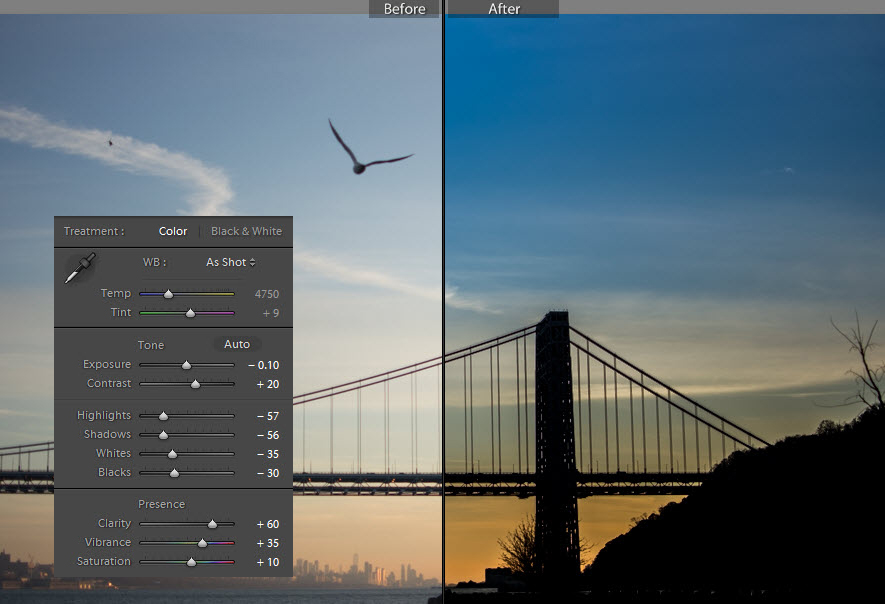
When it came to editing this picture I thought that turning my subjects (Bird, Helicopter, Bridge) into silhouettes would give an interesting affect. Lightroom really is an amazing tool and is what gave me the freedom to easily transform this picture.  As a result of dropping the exposure and other settings such as highlights, shadows, whites, blacks (which I needed to do to get silhouettes) lots of the detail that was in the clouds were revealed.  The last step was to adjust my vibrance and I was left with a picture that looks like it was painted to perfection.

Lightroom editing

Lightroom editing

Out of time

Picture Specs: ISO 400, 35mm, f/1.8, 1/800sec

Picture Specs: ISO 400, 35mm, f/1.8, 1/800sec

Week 14 (11/3/2013 – 11/9/2013): Hoboken Terminal
Picture taken on 11/9/2013 at 4:31 PM

Picture description:

As the days continue to grow shorter and colder it’s becoming harder to find time during the week to snap a picture.  Once winter hits I get the feeling that I’ll be taking more nighttime shots since the sun goes down so early.  Option two would be to take pictures on Saturday and cut it close to the self imposed weekly deadline I adhere to.  Having completed over one quarter of my 52 week blog I’ve come to notice when I’m taking most of my pictures and for that reason I’m going to adjust my weekly window.  Usually I run my week Sunday-Saturday which means I have a weekend day on either side of the week to get a picture.  What I’ve noticed is due to my schedule I hardly every (as in never) take pictures on Sunday but it would be the prime day to write a blog if I take a picture on Saturday. For that reason I’m going to change it up and move my weekly window to Monday-Sunday.  I guess it’s my own daylight savings adjustment.

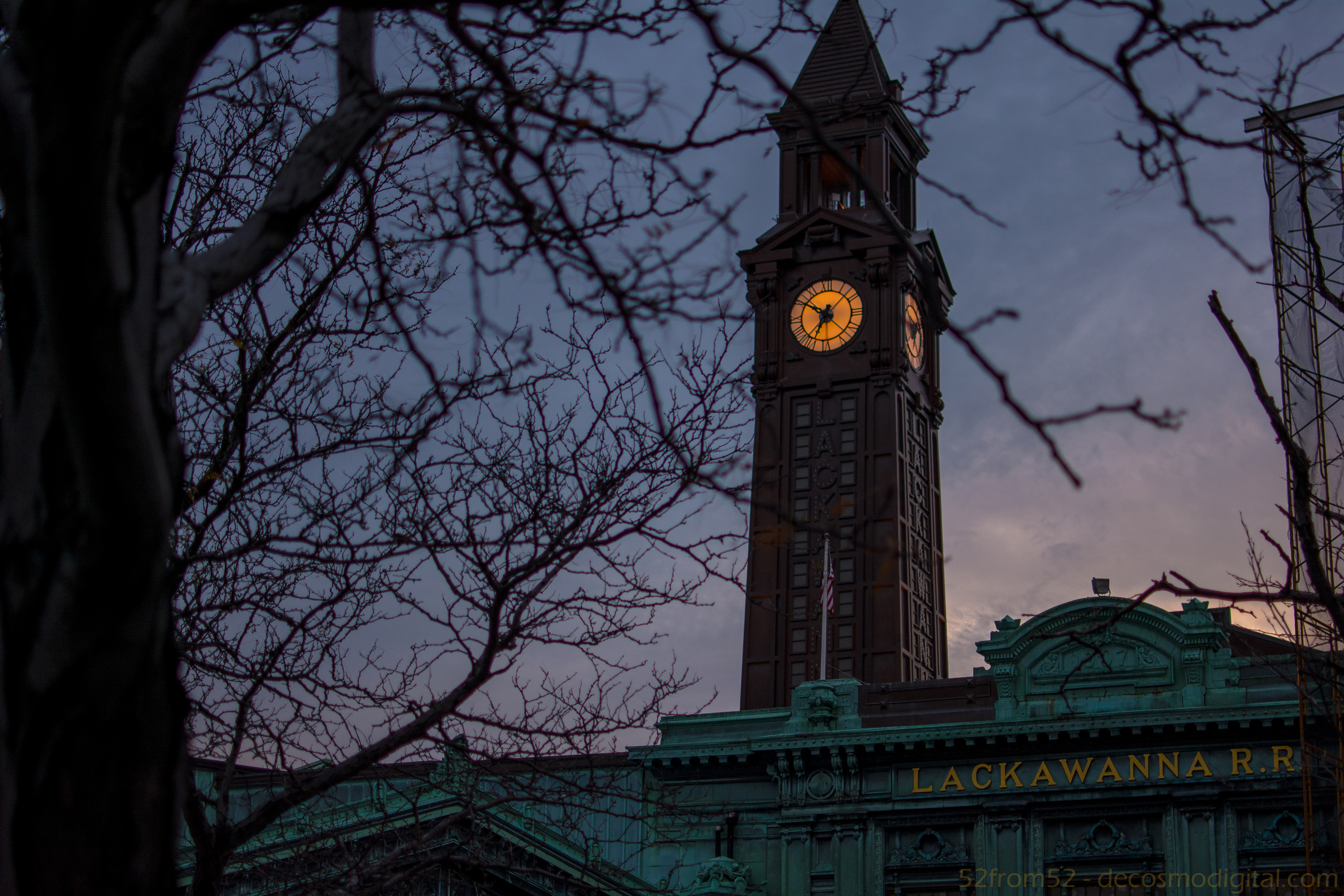
Now that I’ve worked out my time issue let me talk about this week’s picture and how it had a role in my recent decision.  Going into this week my plan was to revisit Top of the Rock (went in June) after work to get a picture looking downtown at sunset.  Unfortunately due to my busy schedule and daylight savings moving sunset times to around 4:30/4:45 this was an impossible goal to accomplish.  This made me realize that if I wanted to continue to take advantage of shooting during the “golden hour” I’ll have to do more of my picture taking on the weekends.  Taking a picture and writing a blog all in one day, especially on Saturday, a day/night I usually go out, can prove difficult.  This is the exact scenario that transpired this week.  My window of opportunity to get the picture I wanted fell to Saturday and in the end I didn’t have the time to make it to Top of the Rock.  Thankfully getting an interesting picture in Hoboken is as easy as taking an afternoon stroll, no planning required.  After setting out to get my picture I began to work my way down the Hoboken waterfront.  As I got closer to downtown  my eye’s were drawn to the train station’s clock tower. With the idea of running out of time in the forefront of my mind a clock picture seemed fitting, all that was left was finding the right angle.

*Never noticed before taking this week’s picture, this clock is not set to the correct time. 

Photography concepts:

As I mentioned in this week’s description section I try to take most of my pictures during what’s referred to as the “golden hour” or “magic hour.”  It’s said that during the “golden hour” you have the best/softest light for taking more dramatic pictures.  Although it’s called the “golden hour” it’s really closer to four total hours a day, one before and one after the sunrise and sunset times.  At these times the sun is at a prime angles for soft light which is roughly 10 to -10 degrees in relation to the horizon.  Having softer light provides lots of advantages for getting a nicely exposed and vivid picture.  Below are two links to some articles which go into more detail about the “golden hour” in case you want to read more.  Back to this week’s picture, I set out to get my picture at the start of the “golden hour” which for Saturday was around 3:45.  I ended up getting my picture just before sunset (4:45) which was good because any later and I might have needed a tripod or  to boost my ISO.

If you’ve been reading my blog or if you’re familiar with photography you might be able to guess how I was able blur out most of the tree and focus on the clock/train station.  In case this is your first time reading this effect is done through the use of a wide aperture, this week’s was f/1.8.  I’ve talked about aperture and it’s affects on an image in many of previous blogs so if you’d like to learn more circle back and read some of my older posts.  The last concept I used which is one I’ve also already talked about during my week 5 post “never forget” is selective focus points.  Just to quickly rehash, on most nice cameras and absolutely every DSLR’s you can manually select one point to base your camera’s focus.  This is different from auto-focus points in that those will often pick up whatever is closest or largest.  I use selective focus points very frequently when shooting with both my DSLR and even my iPhone 5s.  Why leave things to chance, it’s always better to control your focus so this is a tool I highly recommend any photographer uses.

http://www.photographymad.com/pages/view/the-golden-hour-in-photography

How To Make Your Photos Magical

A Day of Reflection

Picture Specs: ISO 500, 35mm, f/9.0, 1/200 sec

Picture Specs: ISO 500, 35mm, f/9.0, 1/200 sec

Week 2 (8/11/2013 – 8/17/2013): Corner of 6th/42nd Bryant Park, New York City
Picture taken: 8/14/2013 at 5:50PM

Picture Description:

If you were to ask me what are my favorite locations in New York City, Bryant Park would absolutely be in my top five.  Although I pass the park almost every day (during my commute to work) I don’t always have the time to stop and enjoy everything it has to offer.  If you’ve spent any amount of time in the park you know it’s a very busy place filled with a diverse group of people.  It’s safe to say there is an activity for almost anyone, year round. One part of the park that I never explored was the New York Public Library.  Yes, for those of you that know me I went into the library, voluntarily!  No I did not borrow any books BUT I did have fun checking out the amazing architecture throughout the building.  At the start of my visit, my plan was to get a picture of the “Rose Main Reading Room” however that didn’t come out as I hoped.  A picture with the 35mm didn’t do the room justice (trust me, Google it) you really need a wide-angle lens, so I decided not to use that picture for this post.

Taken via NYPL’s Photobooth

After exploring the library, I took my adventure outside.  In the heart of the park there were hundreds of people out enjoying the beautiful 70 degree sunny weather.  Both of the park’s restaurants were buzzing and the lawn was littered with people hanging out next to the towering movie screen sitting on the west side of the lawn.  In case you don’t know, HBO has a film festival that runs every Monday during the summer.  The festival makes for a great dinner and a movie idea, but those kind of tips would need a whole other blog so I’ll leave it at that.

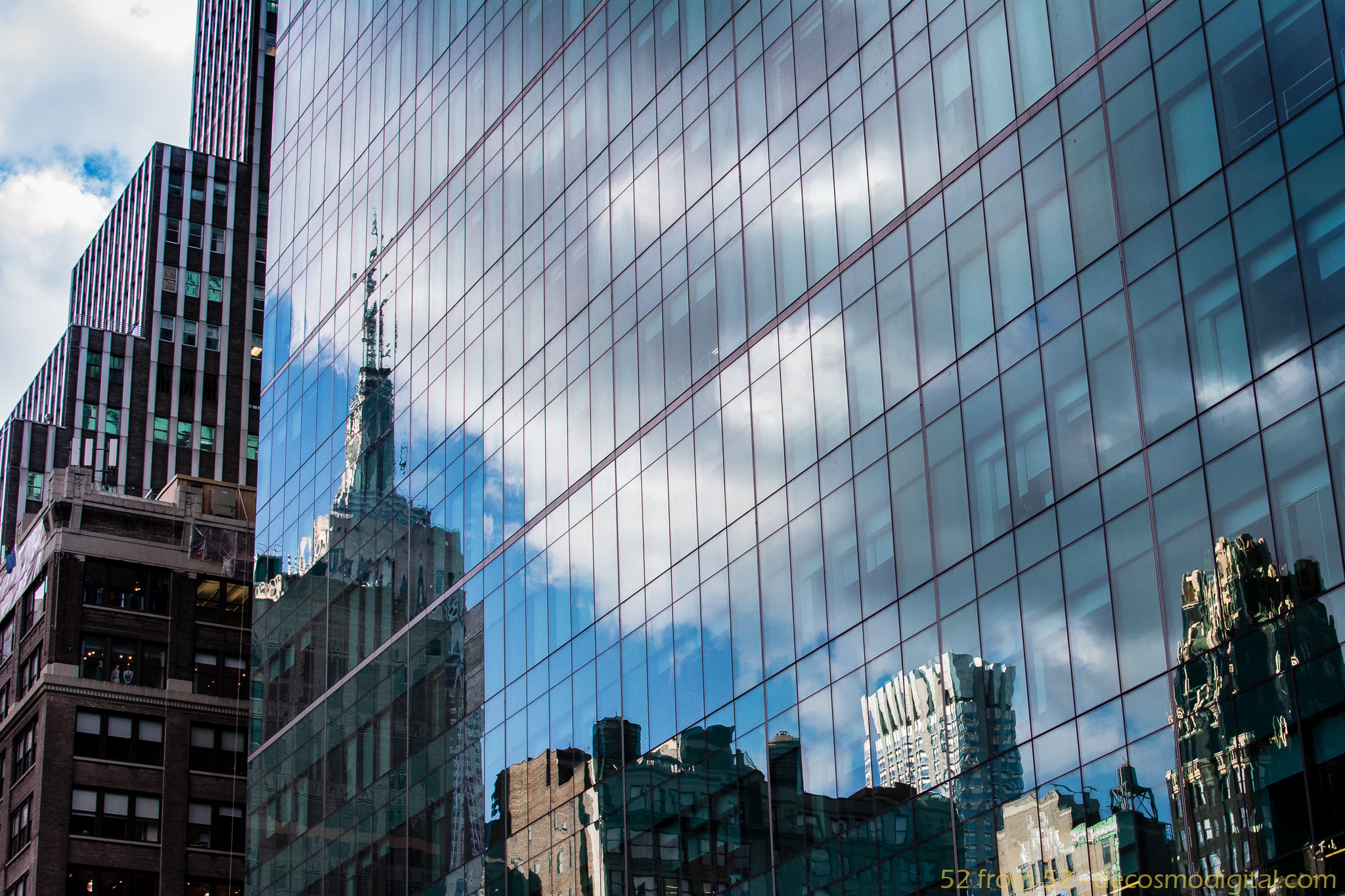
After doing a quick walk-through of the park one thing that immediately caught my eye was how most of the buildings surrounding the park were picking up great reflections of one another.  A reflection shot usually makes for an interesting and unique photo so I decided this would be the perfect idea for this weeks post.

Photography Concepts:

There weren’t a lot of technical intricacies to this week’s photo other than timing.  Prior to going to Bryant Park I knew when the sun would be at the right angle (no pun intended) for some nice shots and maybe even a good reflection picture.  I use an APP on my iPhone called “The Photographer’s Ephemeris” which tells me the angle of the sun based on time/day.  If you’re looking to use the sun as a part of your picture or get a reflection shot I highly recommend using this application when planning your shot.

One composition concept that I attempted to use at least subtly is “leading lines”.  When you look at the picture the lines sort of lead you to the corner of the building where you notice you’re not looking at a blurry picture, you’re actually looking at a reflection.  At least that’s the way I saw it.

Last, when shooting during the day even though there is plenty of natural light, at some points I had to slow down my shutter speed or boost my ISO.  I’ll talk about this more when I take a night picture but take note that for a picture like this when you want everything in focus you need to use a smaller aperture.  I used f/9 which is (based on everything I read) a good aperture for landscapes.  Since a smaller aperture means less light, you have to compensate with a higher ISO or slower shutter speed.

Challenges:

I’m only in week two and I can already see how challenging the 52 from 52 concept is going to be.  Luckily I like a challenge, anything worthwhile takes time and effort.  I put a decent amount of thought into what I wanted to photograph this week.  I naturally have lots of ideas but some of them are about timing (weather, time of day, ect.) while others are location based and require traveling.  With a busy schedule, one of my biggest difficulties will be setting aside the time to go out and take pictures each week…but that’s the purpose of this, to force me to get out there and learn!